Environmentally acceptable lubricants
What makes a lubricant an EAL, the three tests it has to pass, and why performance under load and in water separates one EAL from another.
What is an EAL and where is it required for your vessel
An environmentally acceptable lubricant (EAL) is a lubricant, grease or hydraulic fluid that is readily biodegradable, minimally toxic and not bioaccumulative. If a small amount escapes, it breaks down instead of persisting, and does not poison or build up in marine life.
EALs exist because no stern tube or thruster can be sealed 100% tight. Every propeller shaft seal, thruster, wire rope and piece of deck machinery exposed to the sea is an oil-to-sea interface: a place where lubricant can reach the water in normal operation.
In US waters, EALs have been required at every oil-to-sea interface since the 2013 Vessel General Permit, unless technically infeasible. VIDA carries that requirement into a permanent national standard.
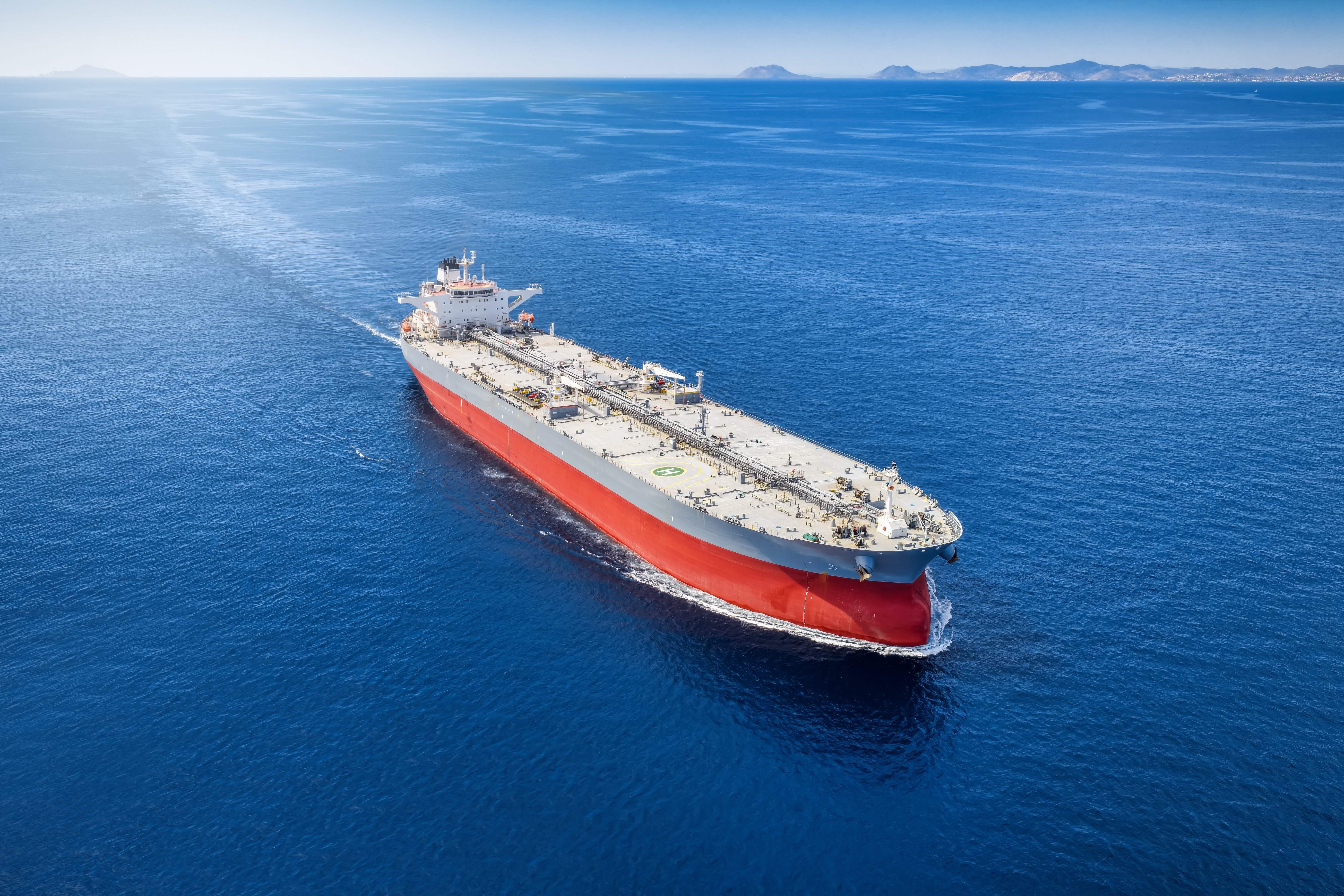
What you need to know about VIDA
Find outWhat a lubricant must prove to be an EAL
-
Biodegradable
Under EPA-recognized OECD and ASTM test methods, a lubricant must demonstrate at least 60% biodegradation within 28 days. In oils and hydraulic fluids at least 90% of the formulation by weight must pass; in greases at least 75%. The remainder must be inherently biodegradable or, in a small share, non-biodegradable but not bioaccumulative.
-
Minimally toxic
Toxicity is measured using standardized OECD aquatic toxicity testing. For fluids, the LC50 must be at least 100 mg/L. For greases and total loss lubricants, at least 1000 mg/L. The lubricant must not cause acute or chronic harm to aquatic organisms at realistic exposure levels.
-
Not bioaccumulative
Bioaccumulation refers to a substance building up in organisms over time. Constituents must not concentrate in the tissue of marine organisms and move up the food chain. Shown by the partition coefficient, or by a molecular mass above 800 daltons.
Passing the environmental tests is the minimum. Performance is the difference
-
A thinner film under load
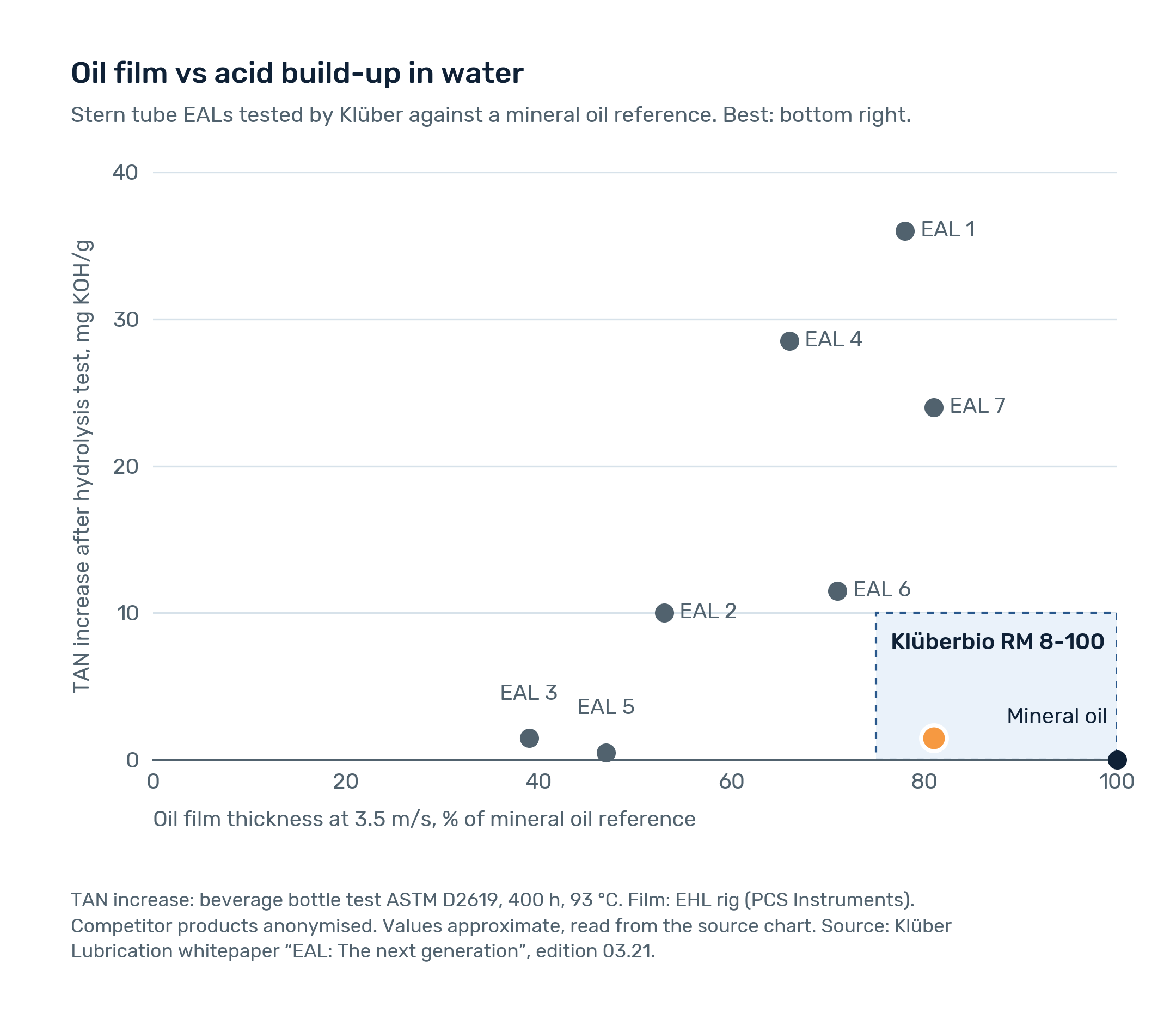
Many esters form a thinner film than mineral oil of the same viscosity grade. At hard manoeuvring or with a partly immersed propeller, that can mean metal contact and aft bearing damage.
-
Hydrolysis and rising TAN
Seawater enters through the same seal that oil leaves by. Weaker esters react with it to form acids: TAN rises, seals suffer and the oil is changed early, unless costly filters and dryers are fitted.
-
Seal compatibility
An EAL that does not suit the elastomer in the propeller shaft seal shortens seal life and raises the risk of leaks in both directions.
WHY KLÜBERBIO
Klüber Lubrication has developed ester-based EALs for propeller shafts and thrusters since 2006. Its newest stern tube oil, Klüberbio RM 8-100, was designed to close the performance gap with mineral oil.
|
The only EAL tested in the target zone
Klüberbio RM 8-100 kept acid build-up near the mineral oil reference while forming about 80% of its film thickness. The other EALs tested either built up acid fast or formed a much thinner film. |
|
Stable in the presence of water
TAN barely rises in Klüber’s hydrolysis test, so water that passes the seal is less likely to force an early oil change or damage the seal. |
|
Designed around the dry-dock cycle
Developed with the goal of oil change intervals that line up with a typical five-year dry-docking schedule. |
|
Built on a proven range
The Klüberbio RM 2 stern tube and EG 2 thruster gear oil series, developed 2006–2013, hold approvals from leading propeller and thruster makers, according to Klüber. |
Understand environmentally acceptable lubricants (EAL) and see how Wilhelmsen Ships Service & Klüber supports valued customer to combine environmental and economic benefits with dedicated EAL specialty lubricant
Understanding EAL in marine lubrication
Total Acid Number, or TAN, offers one of the earliest signals that oil is oxidising, additives are depleting, and corrosion risk is increasing.
Why TAN testing matters for marine lubricant
EAL Greases


EAL Oils


Explore the solution behind the article
Speciality marine lubricantsArticles you might be interested in
-

Why speciality marine lubricants matter for drilling and production assets
Lubrication failures are one of the most frequent root causes of equipment damage offshore. For operators, these failures directly impact safety, uptime, and total cost of ownership.
-
Compressor oils that protect performance, efficiency and vessel uptime
Compressor oil does more than lubricate. Discover how the right lubricant protects vessel efficiency, prevents unplanned downtime, and lowers total operating costs across air, refrigeration and gas compressor systems.
-
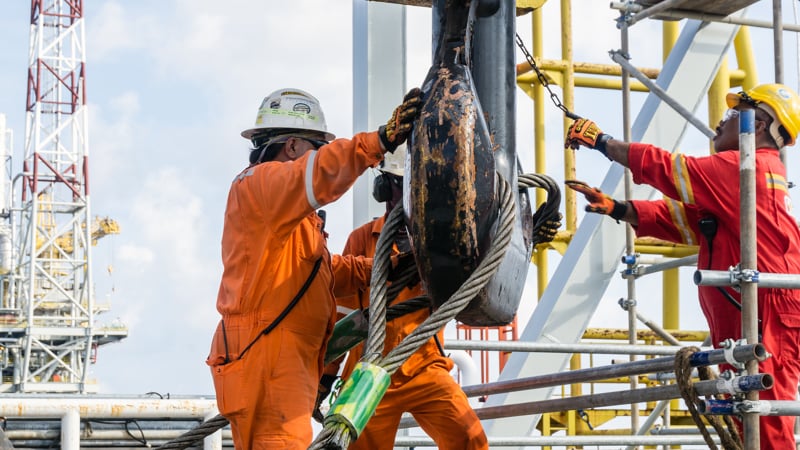
How to prevent wire rope failure in marine offshore environment with better lubrication
Wire ropes in marine and offshore operations are exposed to constant load, movement, saltwater, moisture, and mechanical stress, making proper lubrication critical to safety and reliability. With increasing regulatory focus under US VGP and VIDA, improved grease retention also supports better operational control and reduced incidental discharge risk.
-
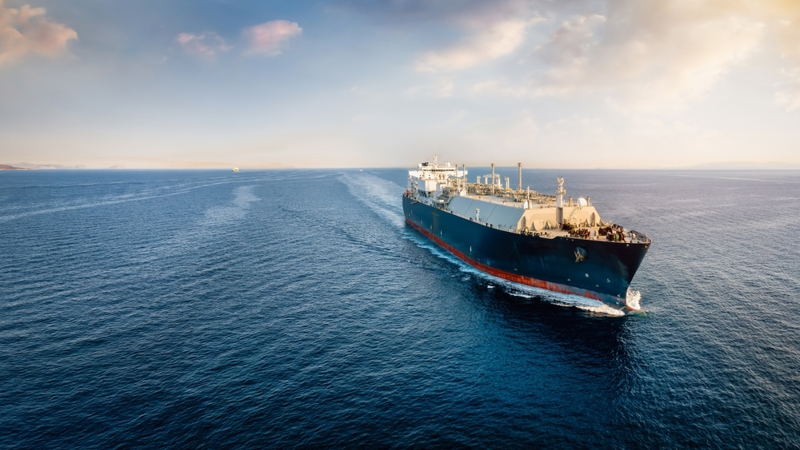
Understanding EAL in marine lubrication
Understand environmentally acceptable lubricants (EAL) and see how Wilhelmsen Ships Service & Klüber supports valued customer to combine environmental and economic benefits with dedicated EAL specialty lubricant