
Why TAN testing matters for marine lubricant condition monitoring
In marine engineering, lubrication oil is often described as the lifeblood of rotating equipment. Engineers routinely monitor viscosity, water content, particle contamination, and wear metals, yet one parameter is frequently underestimated despite its ability to predict lubricant failure long before equipment damage becomes visible: the Total Acid Number, or TAN.
TAN measures the quantity of acidic compounds present in a lubricant, expressed as milligrams of potassium hydroxide required to neutralize the acids in one gram of oil. As lubricants age, oxidation, thermal stress, and additive depletion generate acidic by-products, causing TAN to rise. A rising TAN signals that the oil is losing its ability to protect equipment from corrosion, varnish, sludge, and accelerated wear. For a value this useful, it has to be measured often enough to catch a trend forming, which is where onboard field testing earns its place alongside, rather than behind, the shore laboratory.
This isn't limited to conventional merchant vessels. Offshore assets such as oil rigs and FPSOs run an even larger footprint of lubricated equipment, cranes, riser tensioners, thrusters, winches, and hydraulic power units under continuous heavy load, making consistent TAN trending just as critical there, often more so given the scale of machinery involved.
TAN testing provides the earliest indicator of lubricant degradation
TAN analysis often reveals lubricant distress before any operational symptoms appear. Bearings and gear teeth may still run at normal temperatures and oil may look visually acceptable, even while chemical degradation is already underway. As oxidation progresses, acidic compounds accumulate, attacking metallic surfaces, depleting additives, and promoting varnish and sludge. Left unchecked, this leads to corrosion, seal deterioration, filter blockage, and premature component failure. TAN therefore serves as a leading indicator rather than a lagging one, invaluable for equipment operating continuously for months between dry-dockings or offshore campaigns, provided it's checked on a rhythm tight enough to catch the trend while it's still forming.
On board field testing
TAN is only as useful as the frequency with which it's measured. A single result sent to a shore laboratory every few months tells an engineer where the oil stood on the day it was sampled, not what's happening now, the core argument for making a practical field test kit the primary, day-to-day tool for TAN trending onboard, with laboratory testing used as a periodic reference rather than the sole data source.
The newly launched Unitor™ Total Acid Number (TAN) Kit (PN 673160) is built exactly for this purpose. Using a drop-count colorimetric titration, engine room staff can run a TAN check in minutes with a small oil sample, a colour-indicator reagent, and a simple drop-titration procedure requiring no specialized chemistry training. The sample is mixed with a reagent that turns red in the presence of acidic compounds; titrant is added drop by drop until the colour shifts back to green, and the drop count, multiplied by a factor set for the sample size, gives an estimated TAN in mg KOH/g. Completed right at the machinery, it fits naturally into routine watchkeeping, putting a reliable, repeatable trending tool directly in the crew's hands, whether on a vessel or an offshore platform.
This is what makes the Unitor™ TAN kit valuable for trending, even though it's less precise than laboratory instrumentation: trending depends on frequent, consistent data points showing direction and rate of change, not laboratory-grade precision at any single reading. Used at regular intervals by the same crew member, it will surface a developing upward trend far sooner than a quarterly laboratory sample, allowing a purifier run, additive check, or oil change to be scheduled before the acids do meaningful damage to gears, bearings, and seals.
Laboratory testing still has an essential role as a reference and verification layer rather than the primary trending method, periodic samples confirm field kit readings remain consistent with a controlled benchmark, catch any drift in reagent quality or operator technique, and provide higher-precision data for major maintenance decisions. Because field kits and lab methods rely on different detection principles, results aren't always numerically identical; what matters is that the same method is used consistently over time, so a switch mid-trend doesn't get mistaken for a real change in oil condition.
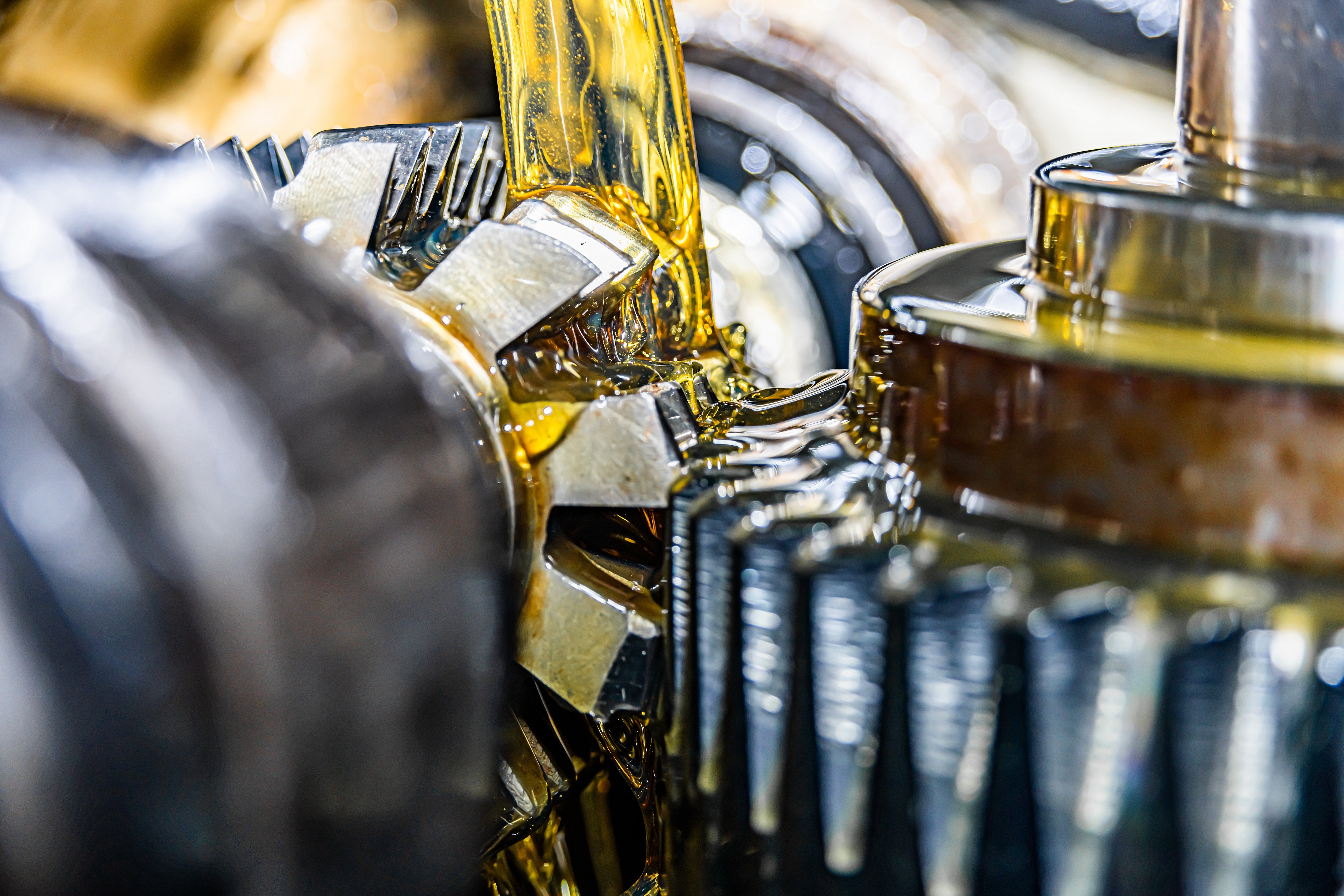
Proposed on board testing frequency
How often TAN should be checked depends on how critical the equipment is and how hard it's running, rather than a single fixed interval. ASTM D6224 sets out sampling and testing schedules for gears, hydraulic systems, and similar equipment on this same criticality basis, and industry condition-monitoring guidance built on that principle generally recommends monthly testing for high-criticality assets such as turbines, hydraulic systems, and gearboxes in primary service, quarterly for less critical equipment. Applied to a vessel or offshore installation, that supports monthly checks for propulsion gearboxes, thruster gearboxes, and high-pressure hydraulics, including crane and riser-tensioner hydraulics on rigs and FPSOs, with quarterly checks for lower-criticality equipment such as deck machinery and winches, stepped up if a reading trends upward.
An unscheduled check is also warranted after any known high-temperature excursion, suspected contamination event, or maintenance work that opens a system to potential ingress. A baseline TAN reading should be logged whenever fresh oil goes into a system, since all future trending is measured against that starting point. As a general rule, a single-interval jump of roughly 0.15 mg KOH/g or more signals thermal stress or contamination requiring immediate investigation, distinct from the slower, gradual rise of ordinary oxidative aging. Consistency matters more than precision here: a fixed rhythm, logged against the same baseline, is what produces a usable trend line.
References: ASTM D6224; Tractian, "Total Acid Number"; AELAB, "Oil Condition Monitoring Laboratory Equipment"; TANHON, "How To Test Industrial Gearbox Oil Condition."
TAN limits across major lubricant brands
A common misconception is that TAN only matters when a lubricant supplier specifies a condemnation limit. In practice, most major lubricant manufacturers and oil analysis laboratories treat TAN trending as core to condition-based maintenance, and companies such as Mobil, Shell, Chevron, and Klüber invest in oxidation resistance because acid formation is a primary driver of lubricant degradation.
Industry standards generally avoid a single universal TAN condemnation limit, since fresh oils start at different baseline values depending on chemistry and additives. A widely cited rule of thumb flags investigation once TAN approaches roughly twice its new-oil value, though practitioners prefer limits set empirically from historical trend data and OEM recommendations. Regardless of brand, the absolute TAN value matters less than the trend, and a steadily increasing TAN is frequently a stronger warning sign than any single reading, exactly the signal frequent onboard testing with a tool like the WSS TAN Kit is positioned to catch.
TAN as the primary indicator in gearboxes and hydraulic systems
Propulsion gearboxes, thruster gearboxes, and hydraulic power systems illustrate why TAN deserves attention as a primary trending parameter rather than a secondary check. Unlike systems routinely exposed to seawater, these units are sealed and aren't typically expected to take on water contamination, so the dominant threat to oil health is oxidation and additive depletion driven by heat, load, and time in service, precisely what TAN is designed to detect. This holds even with premium lubricants: Chevron, Shell, and Klüber market gear and hydraulic oils on strong oxidation stability, but a gear oil with good additives can still oxidize faster under sustained high temperatures, and a hydraulic system can still see additives deplete under heavy cyclical loading, common on offshore platforms running cranes and tensioning equipment around the clock. No lubricant can compensate indefinitely for excessive temperatures, extended change intervals, or equipment defects, which is exactly where routine onboard TAN monitoring adds value: it measures actual in-service condition rather than theoretical capability.
Fresh gear oil typically starts around 0.3 to 0.8 mg KOH/g, and as oxidation sets in, TAN rises gradually; a widely used threshold treats 2.0 to 2.5 mg KOH/g as the point where reserve alkalinity is significantly lost and oxidation risks becoming self-perpetuating, making replacement urgent. Other guidance uses a tighter trigger, a rise of around 0.5 mg KOH/g over baseline, with a sudden single-interval jump signaling thermal stress or contamination needing immediate investigation. Because marine reduction gearboxes from manufacturers such as Renk, Flender/Siemens, Reintjes, and Brunvoll are common across commercial vessels and offshore support craft alike, this trending approach applies fleet-wide.
TAN trending also pays for itself literally: regular sampling is low-cost insurance against cascading failures, since an analysis costing tens of dollars can catch degradation early enough to avoid replacements running into the tens or hundreds of thousands once a failure cascades through a gear train. TAN's role shifts by system, a secondary, confirmatory test in equipment exposed to contamination risks like water ingress, but the primary trending parameter in its own right in sealed, oxidation-dominated systems, since the acid formation curve is the story. Either way, the earlier and more frequently TAN is checked, the more useful it is as a predictive tool rather than a post-mortem explanation.
While premium lubricants from Klüber, Mobil, Shell, and Chevron are engineered for strong oxidation resistance and long service life, none eliminate the need for routine TAN monitoring. TAN remains one of the most sensitive indicators of lubricant ageing and corrosion risk, and its diagnostic role is strongest in sealed, oxidation-dominated systems, propulsion gearboxes, thruster gearboxes, and hydraulic systems, whether on a vessel or an offshore platform. Its true value lies not in a single laboratory result but in its trend over time.
For critical assets such as gearboxes, thrusters, winches, and deck or platform machinery, the most practical way to capture that trend is to make onboard field testing part of the routine maintenance rhythm, with periodic laboratory testing kept as a reference check rather than the primary data source. The newly launched Unitor™ TAN Kit (PN 673160) gives crews a fast, repeatable way to do exactly that run consistently, it will surface a developing problem long before a quarterly laboratory sample would.
Explore the solution behind the article
Speciality marine lubricantsArticles you might be interested in
-

Why speciality marine lubricants matter for drilling and production assets
Lubrication failures are one of the most frequent root causes of equipment damage offshore. For operators, these failures directly impact safety, uptime, and total cost of ownership.
-
Compressor oils that protect performance, efficiency and vessel uptime
Compressor oil does more than lubricate. Discover how the right lubricant protects vessel efficiency, prevents unplanned downtime, and lowers total operating costs across air, refrigeration and gas compressor systems.
-

How to prevent wire rope failure in marine offshore environment with better lubrication
Wire ropes in marine and offshore operations are exposed to constant load, movement, saltwater, moisture, and mechanical stress, making proper lubrication critical to safety and reliability. With increasing regulatory focus under US VGP and VIDA, improved grease retention also supports better operational control and reduced incidental discharge risk.
-

Understanding EAL in marine lubrication
Understand environmentally acceptable lubricants (EAL) and see how WSS & Kluber supports valued customer to combine environmental and economic benefits with dedicated EAL specialty lubricant