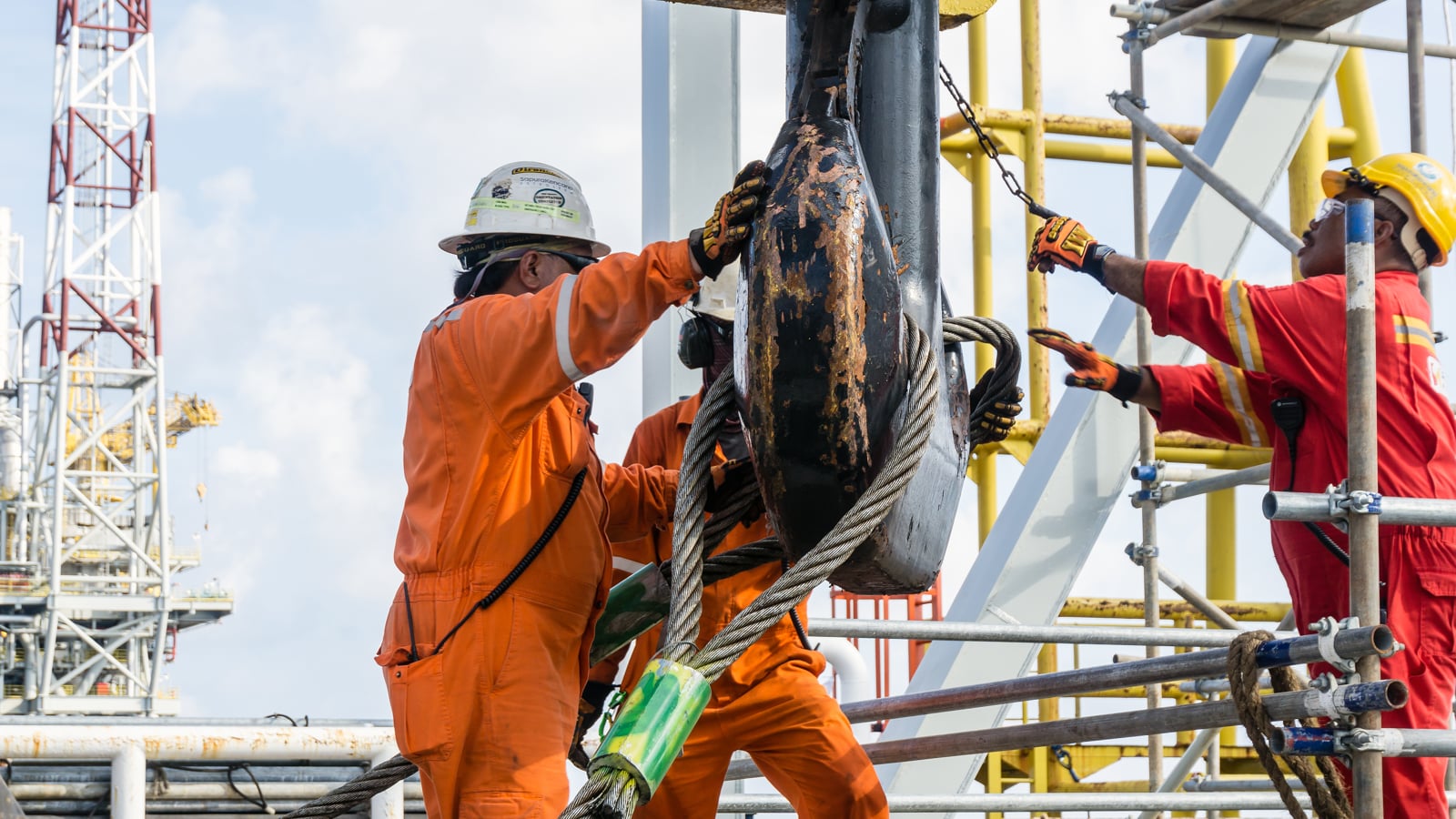
How to prevent wire rope failure in marine offshore environment with better lubrication
Wire rope is one of the most important working components in marine, offshore, and industrial operations. It carries heavy loads, handles constant movement, and operates in environments where moisture, salt, dirt, and mechanical stress can quickly accelerate wear. Yet despite its critical role, wire rope lubrication is still often treated as a routine task rather than a performance and safety issue.
That is where problems begin. Wire ropes rarely fail all at once. In most cases, they deteriorate gradually from the inside out, long before external damage becomes obvious. By the time corrosion, broken wires, or surface degradation are visible, the rope may already have suffered internal wear that cannot be reversed.
Across vessel visits and technical discussions, one issue is raised repeatedly by crews and superintendents: wire rope grease dripping or slinging off during operation. This behaviour is often accepted as normal. From a lubrication perspective, it is not.
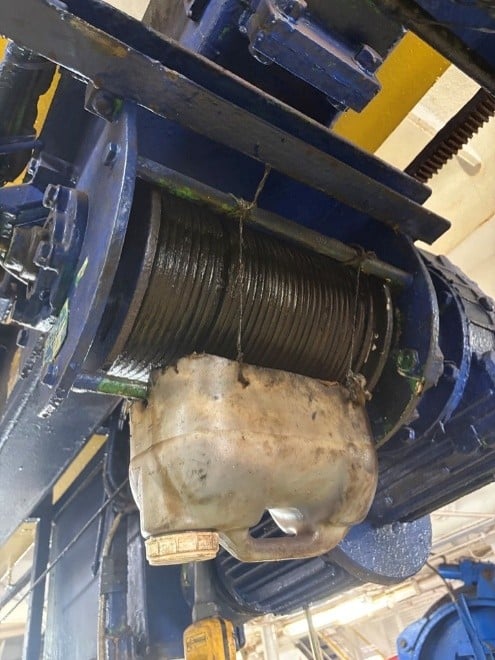
When the grease leaves the rope it is meant to protect, that protection is compromised and the consequences are predictable. The rope is more vulnerable to accelerated wear and corrosion, individual wires and strands lose protection, grease consumption increases because of repeated application, lubrication intervals become shorter and more labour-intensive, and housekeeping and safety concerns can also arise on deck and around equipment.
This is why proper lubrication is not simply about reducing friction on the surface. It is about protecting the rope structure, preserving integrity, and extending service life.
Wire rope is a complex system, not just a bundle of steel wires. Every bend, load cycle, and movement creates internal friction between wires and strands. Without the right lubricant, that friction leads to heat, wear, and corrosion. Over time, the rope becomes more vulnerable to stiffness, cracking, loss of flexibility, and eventual failure. In demanding applications, even a small loss of lubrication quality can have a large impact on reliability.
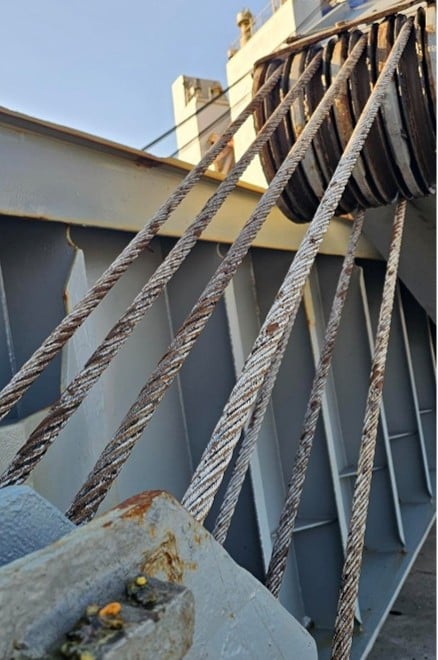
A specialist lubrication approach becomes necessary when standard maintenance methods are no longer enough to protect the rope properly. In these situations, simply applying grease to the outside of the rope is not enough. The lubricant must penetrate the rope structure and reach the internal wires where wear begins. Klüberbio AM 92 142, is developed specifically for wire rope applications in marine and offshore service. Rather than being adapted from multipurpose greases, it is designed around real operating behaviour of wire rope operation where lubrication is continuously subjected to wash‑off, motion, and load.
Klüberbio AM 92‑142 delivers efficiency by maintaining strong adhesion to individual wire strands, and resisting fling‑off and drip‑off even at elevated operating temperatures (dropping point >170 °C). This results in reducing overall grease loss. In standardized ASTM D‑4049 water spray‑off testing, Klüberbio AM 92‑142 showed a mass loss of only 14% after five minutes of water spray, compared with 90 - 95% loss for competing EAL wire rope greases.
For offshore applications, lubrication is exposed to sustained hydrostatic pressure and the risk of seawater ingress, both of which can significantly affect grease behaviour. These are not theoretical conditions; they are the realities of subsea operation, where the lubricant must continue to protect the rope despite pressure, moisture, and long exposure times.
To validate performance under these conditions, a hyperbaric test was conducted at 250 bar, equivalent to approximately 2,500 metres depth, over 48 hours in a 3.5% NaCl solution simulating seawater. The objective was straightforward: to determine whether the grease would retain its structure and protective properties under subsea conditions.
The test results showed that after exposure, penetration remained stable, moving only from 269 to 266–275 mm/10. Water content increased, but remained very low at around 0.2% maximum, while shear viscosity also remained stable, shifting only slightly from approximately 10,329 to 9,839 mPa·s. These results indicate that the grease maintained its physical integrity and did not experience meaningful structural breakdown under pressure.
What this means is that the grease limits water ingress into its matrix and continues to retain its lubrication properties after exposure. In other words, performance under subsea conditions is not merely assumed but demonstrated and proven. That distinction matters, especially in environments where reliability and protection cannot be left to chance.
With increasing regulatory focus under US VGP and VIDA frameworks, grease behaviour onboard is also coming under greater scrutiny. Grease that leaves the rope can contribute to incidental discharge during operation and in harsh weather, creating compliance exposure and additional operational controls. In that context, regulatory readiness becomes a direct result of lubrication performance, not simply the result of extra procedures.
Wire rope lubrication is therefore no longer defined only by whether a product can be applied to the rope. It is defined by retention, stability, and performance under real operating conditions. Klüberbio AM 92 142 represents that specialist approach, engineered to help control grease loss and maintain protection in demanding marine and offshore environments. Because in wire rope lubrication, what stays on the rope protects it, and what leaves the rope drives cost, risk, and inefficiency.
Explore the solution behind the article
Speciality marine lubricantsArticles you might be interested in
-
Why speciality marine lubricants matter for drilling and production assets
Lubrication failures are one of the most frequent root causes of equipment damage offshore. For operators, these failures directly impact safety, uptime, and total cost of ownership.
-
Compressor oils that protect performance, efficiency and vessel uptime
Compressor oil does more than lubricate. Discover how the right lubricant protects vessel efficiency, prevents unplanned downtime, and lowers total operating costs across air, refrigeration and gas compressor systems.
-
How to prevent wire rope failure in marine offshore environment with better lubrication
Wire ropes in marine and offshore operations are exposed to constant load, movement, saltwater, moisture, and mechanical stress, making proper lubrication critical to safety and reliability. With increasing regulatory focus under US VGP and VIDA, improved grease retention also supports better operational control and reduced incidental discharge risk.
-
Understanding EAL in marine lubrication
Understand environmentally acceptable lubricants (EAL) and see how WSS & Kluber supports valued customer to combine environmental and economic benefits with dedicated EAL specialty lubricant