Freeze protection across every maritime segment
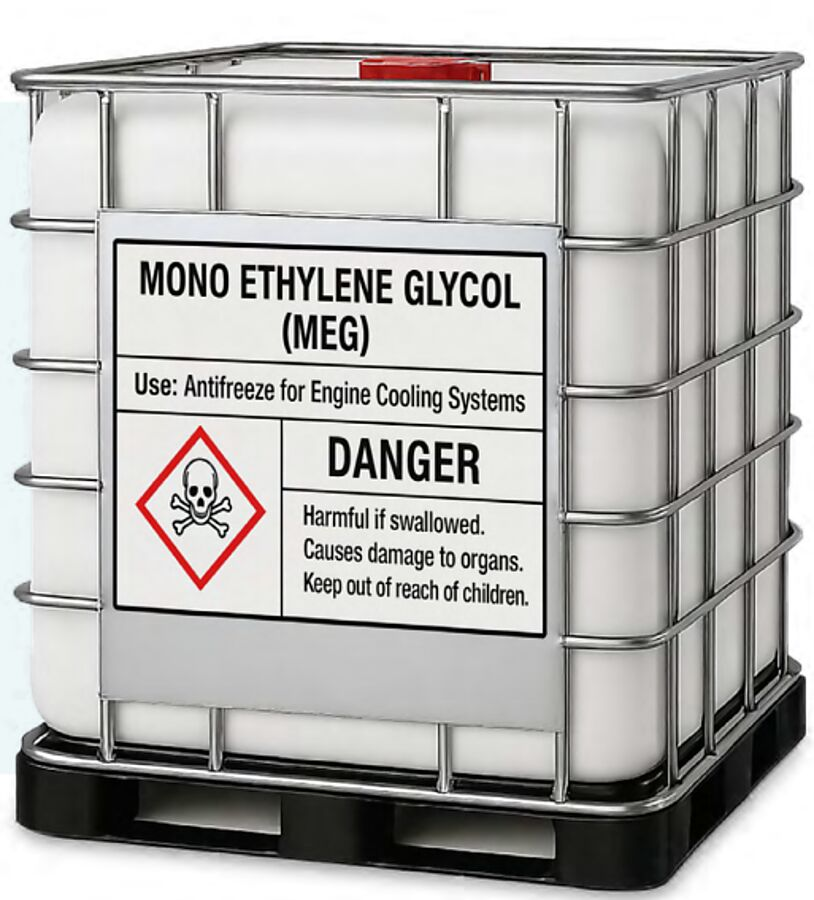
Mono Ethylene Glycol (MEG) flexible supply to match your operations
-
Flexible delivery options in IBC or ISO Tank to suit your operational requirements
-
18 countries with barging and pumping where conditions allow
-
99% minimum product purity, with water content help to max 0.2%
Mono Ethylene Glycol (MEG) from the WSS team you already know and work with.
One account, one network, one point of contact now supporting MEG in bulk supply (IBC/ ISO tank) across . Share your , and we’ll work on a competitive solution tailored to your requirement
| 1 |
Tell us the requirement |
System volume, target protection temperature, port and date. If you only have some of that, we can work from what you have. |
| 2 |
Choose the delivery mode |
IBC tanks, tank truck or bulk transfer, matched to the port, the crane and the window you have. |
| 3 |
Delivered with paperwork |
Documentation for IHM and the product specification arrive with the delivery, not weeks after it. |
Quality assurance
A controlled specification with the documentation to support it, which matters when an inspector, a class surveyor or an engine maker's warranty claim asks the question.
| CAS number | 107-21-1 |
| Purity | Min 99% |
| Water content | Max 0.2% |
| Density | 1.11 to 1.12 g/ml |
| Appearance | Clear colourless liquid |
| IMO / EU invent hazard material | C-8 |
For optimal performance and controlled quality, prepare dilutions with deionised or distilled water. Water quality is part of the specification, not a detail.

-
LNG fuel systems
Used in FGSS, vaporizers, and heat exchangers to ensure stable LNG operation.
-
Closed cooling water systems
Provides freeze protection and efficient heat transfer for engines and auxiliary equipment.
-
Emergency generators
Prevents freezing of pipelines, equipment and critical systems in low temperature conditions.
-
HVAC systems
Ensures reliable performance of chilled water and HVAC systems across all climatic conditions.
-
Heat exchangers
Enhances heat transfer efficiency and prevents freezing within heat exchange circuits.
-
Offshore applications
Used in offshore platforms, FPSOs and rigs for cooling, heat transfer and process reliability.
Ready your fleet before the cold arrives
High-purity MEG in IBC or ISO tank across 18 countries, with IHM documentation in every delivery
See the MEG specificationNeed advice and support?
Articles that you might be interested in
-

What shipowners need to know about SOx & NOx as Canadian Arctic joins the ECAs
The global Emission Control Area framework is expanding once again. With the Canadian Arctic and the Norwegian Sea designated as new ECAs under MARPOL Annex VI, shipowners face stricter sulphur and nitrogen oxide requirements across a broader portion of their trading routes.
-

The hidden operational risks of poor emission control chemical management
Emission control systems are only as reliable as the chemicals that support them. While much attention is placed on hardware such as scrubbers and SCR units, the quality and consistency of chemicals like urea and caustic soda play an equally critical role.
-

Managing SCR urea procurement in 2026
Global urea supply has become more volatile in 2026 due to geopolitical disruption, rising energy costs, freight pressure, and tightening availability across Asia, Singapore, Europe, and the USA. Learn what this means for marine SCR compliance, procurement planning, and supply risk management.
-

What happens when poor-quality urea enters your SCR system
SCR systems are engineered to operate with urea that meets strict international quality standards. Any deviation in concentration or the presence of unwanted impurities can interfere with the chemical reaction and lead to injector blockages, catalyst degradation, unplanned maintenance.