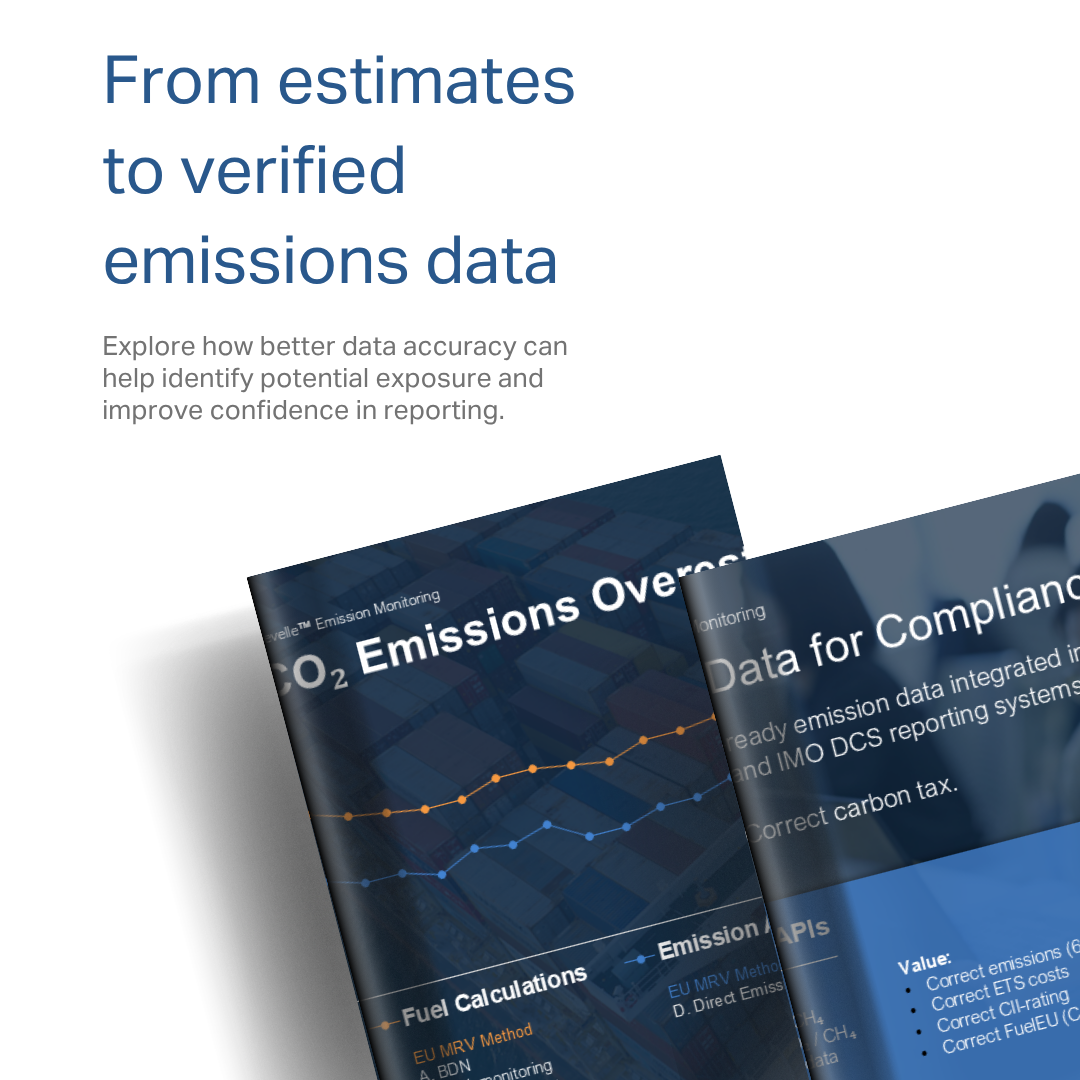
Close your vessel emissions accuracy gap
Request access to Revelle insights and learn how vessel operators are approaching emissions accuracy, reporting challenges, and potential ETS exposure in today’s regulatory environment.
Why fuel-based methods can lead to higher compliance cost
-
Generic emission factors
The gap between assumed and actual emissions is driven by fuel that is estimated but not actually consumed.
-
Incomplete combustion
Not all carbon becomes CO2, a share becomes CO, HC and methane slip, however fuel-based formulas count it all as CO2.
-
Sludge removal
Purification systems remove sludge from fuel prior to combustion. This sludge is recorded as consumed in tank monitoring and BDN records, but it is never burned
-
Manual measurement errors
BDN variances, tank sounding, and manual data entry each introduce small but compounding errors into the fuel consumption baseline that carry through the emission calculation.
-
Perfect combustion assumption
Fuel-based methods assume complete, efficient combustion at all engine loads. Engines operate at varying loads and their combustion efficiency changes as the load changes.
The Revelle solution: designed to align with evolving maritime regulations
-
EU Monitoring, Reporting and Verification
Revelle™ delivers actual emission values with the data quality score and traceability required for annual MRV report submission and verifier sign-off.
-
Data Collection System
Data from Revelle's sensor stream feeds directly into reporting requirements, providing actual data rather than assumptions.
-
FuelEU greenhouse gas intensity
FuelEU obligations incorporate CH₄ and N₂O alongside CO₂. Revelle directly measures all three, providing the methodology-aligned data needed for defensible FuelEU compliance reporting.
Revelle™ 3.0: how it works
EU MRV Method D.
Direct, verified, and in real time, Method D (direct emission monitoring) is the only EU MRV methodology that measures what actually exits the exhaust. Revelle's system installed on your vessel delivers continuous emission data.
Three independent sensor streams; emissions, fuel, and engine load, are cross-verified continuously. Discrepancies between streams trigger automatic quality flags.
Audit-ready data delivered into your systems
Revelle™ does not replace your reporting platform. It feeds verified, method-D emission data directly into your existing EU MRV and workflows via API with meeting requirements for regulatory submission and third-party verification.