
Why MGO management matters more than ever in the growing ECAs
As emissions regulations continue to tighten across the maritime industry, IMO has extended the ECA (Emission Control Area) designation to the Norwegian Sea and Canadian Arctic, effective from 1st March 2026, and potentially the North-East Atlantic Ocean, with specific compliance timelines and requirements.
Traditionally, vessels operating on heavy fuel oil (HFO) or very low sulphur fuel oil (VLSFO) benefit from relatively stable fuel conditions. However, operating in and out of ECAs requires frequent switching between fuel types typically from HFO/VLSFO to MGO. This change introduces greater sensitivity across the fuel system, exposing the fuel system to faster swings in viscosity and temperature, increasing sensitivity to fuel cleanliness, water management, lubricity margin, microbial contamination, cold-flow behavior, and deposit control.
Key challenges when operating on MGO
| Pain points | Root cause | Operational challenge |
| Water sensitivity | Water ingress & condensed water in fuel tank (unavoidable) |
|
| Lack of lubricity | Lower viscosity of MGO (compared with HFO/VLSFO), leading to boundary/Mixed lubrication regime (during frequent switch-over period) |
|
| Storage stability | Poor resistance to oxidation (particularly when heated) |
|
| Low-temperature operability | Paraffinic (as wax) in MGO, high CFPP/pour point. No heating condition |
|
A structured approach to MGO management
As operating conditions become more complex, fuel should no longer be treated as a passive consumable. Instead, it should be actively managed as a critical input to engine reliability. Wilhelmsen Ships Service offers a comprehensive approach to maintaining fuel integrity across the entire fuel lifecycle from bunkering and storage to transfer and injection.
This ensures stable quality in tanks, controlled water contamination, adequate lubrication margin, acceptable cold operability, and minimized deposit formation. Rather than relying on a single treatment approach, a structured additive programme allows operators to address specific risks associated with MGO and bio-MGO. The Unitor DieselPower Series enables a modular program where each additive is selected based on a specific risk mechanism to mitigate operational challenges onboard
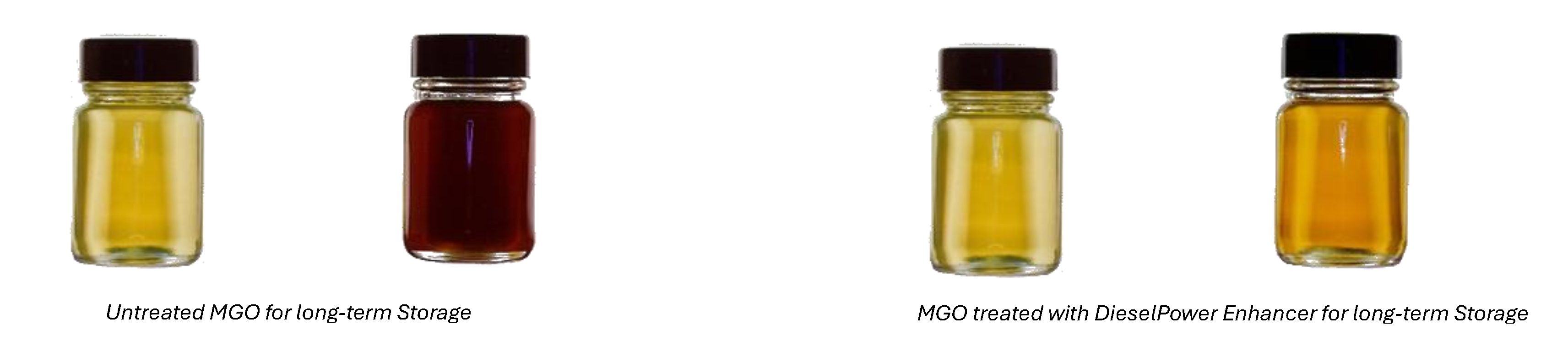
- DieselPower Enhancer (baseline conditioning) supports overall fuel conditioning by improving oxidation stability, reducing sludge formation, and enhancing lubricity for standard MGO operations. Extended storage onboard for 3 months over*
- DieselPower BioEnhancer (baseline conditioning) is designed for biofuel blends, helping maintain fuel stability, improve cleanliness, and protect against corrosion in Bio-MGO applications. Extended storage onboard for 3 months over*
- DieselPower Lubricity (hardware protection) improves the lubrication properties of low-viscosity fuels, helping to protect fuel pumps and injectors from wear. 34% lubrication improvement, certified by LR Product Verification Scheme*
- DieselPower CFPP (cold operability) enhances cold flow properties, reducing the risk of wax formation and filter blockages in low-temperature conditions. Average 10~15 CFPP reduction at optimal dosage, certified by LR Product Verification Scheme*
- DieselPower BioControl (microbial control) addresses microbial contamination by preventing and eliminating bacterial growth in fuel systems. Highly effective biocide certified by LR Product Verification Scheme*
- UnitorTM Bacterial Single Test Kit: User-friendly onboard test kit for bacterial contamination for timely corrective action
*Based on independent 3rd party lab trial test and report
If your fleet is increasing MGO running hours due to expanding ECA coverage, now is the time to take a more structured approach to fuel management. By adopting a structured approach to MGO management, you can reduce operational risk, extend equipment life, and improve overall efficiency while remaining compliant with evolving environmental standards.
Articles you might be interested in
-
How to choose the right fuel and lube oil test kit for your vessel
This guide is intended to support chief engineers and technical superintendents in selecting onboard test kits that align with vessel size, engine configuration, fuel strategy, and operating profile.
-

Safeguarding your fuel system
Microbial contamination: the silent threat hiding in your fuel tanks as marine fuels evolve, so do the risks. Microbial growth fueled by water ingress is quietly degrading fuel quality, threatening vessel safety, and driving up maintenance costs. In this article, Wilhelmsen experts unveil the Prevent – Test – Treat (PTT) methodology, an integrated, proactive approach to fuel management that helps you stay ahead of microbial risk. Discover how simple steps can protect your fuel, your crew, and your bottom line. Read on and contact us to safeguard your operations.
Wilhelmsen insights |
Alex Qiang, Head of Product Management - Fuel & Lubricant Solutions -
Embrace fuel diversity for the future
Post IMO 2020, the fuel challenges remain unchanged while being more complicated when Very Low Sulphur Fuel Oil (VLSFO) was implemented in 2020 to be compliant with IMO 2020 regulation. The fuel diversity in the market including residual fuel type (HSFO/VLSFO/ULSFO), distillate fuel type (LSMGO/Diesel), Bio-blends (Bio-VLSFO/HFO, Bio-LSMGO), etc. Invite new challenges and risks.
Wilhelmsen insights |
Alex Qiang, Head of Product Management - Energy Solutions -
Managing fuel quality issues and meeting regulatory requirements
For shipowners and operators, maintaining fuel quality at a time of tightening regulation requires a clear understanding of the challenges
Wilhelmsen insights |
Shawn Lim, Head of Technical Sales and Business Development East, WSS Emissions, Fuels & Lubes
Featured Offers
-

Why MGO management matters more than ever in the growing ECAs
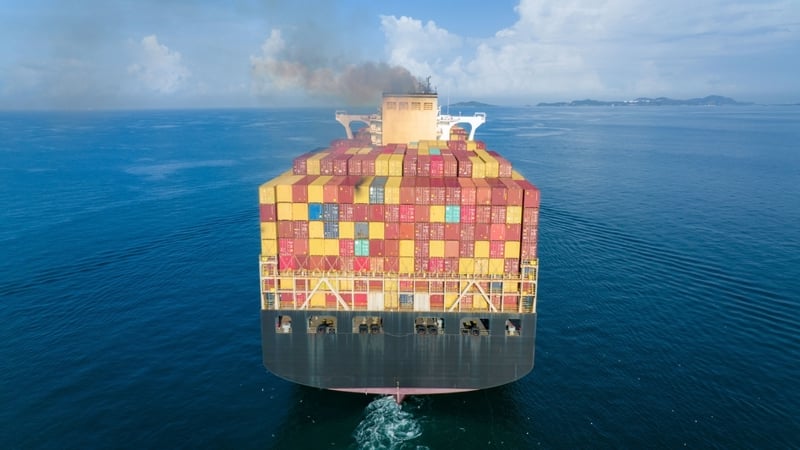
As the Emission Control Areas (ECAs) expand, more vessels will need to operate on marine gas oil (MGO) or bio-MGO for extended periods. While this shift supports environmental compliance, it also introduces new operational challenges that cannot be overlooked.
-
Fuel oil treatment offers benefits to enhance vessel operational efficiency on road to decarbonization
With shipping currently responsible for 3% of global GHG emissions, the new EEXI and CII regulations that came into force in January comprise the IMO's short-term measures to address climate change. The aim is to reduce carbon intensity of all vessels with over 5,000 GT in international trading by 40% by 2030 and 70% by 2050 – an ambitious target for the maritime community to pursue.
Wilhelmsen insights |
Jonas Östlund, Head of Product Management - Energy Solutions -
Is your blended fuel compatible? Simple onboard testing explained
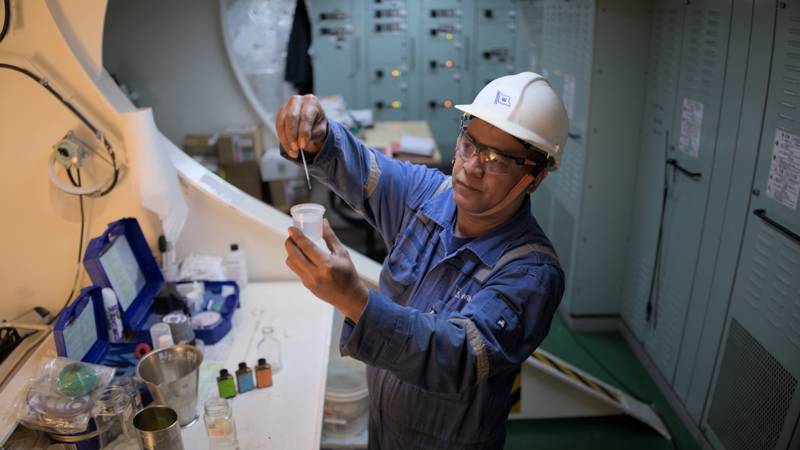
As VLSFO formulations vary and biofuel blends become more common, many vessels are now handling a wider range of fuel chemistries than ever before. Without a simple check up front, the first sign of trouble may be blocked filters, overloaded separators, or rising sludge volumes.
-
Safeguarding your fuel system
Microbial contamination: the silent threat hiding in your fuel tanks as marine fuels evolve, so do the risks. Microbial growth fueled by water ingress is quietly degrading fuel quality, threatening vessel safety, and driving up maintenance costs. In this article, Wilhelmsen experts unveil the Prevent – Test – Treat (PTT) methodology, an integrated, proactive approach to fuel management that helps you stay ahead of microbial risk. Discover how simple steps can protect your fuel, your crew, and your bottom line. Read on and contact us to safeguard your operations.
Wilhelmsen insights |
Alex Qiang, Head of Product Management - Fuel & Lubricant Solutions