
Class verification: Up to 2.17% fuel oil saving and 31% prolonged stability
ISO 8217:2024 formally expands the scope of marine fuels to include up to 100% FAME in permitted grades, acknowledging biofuels as a practical decarbonization pathway. However, CIMAC WG7 clearly emphasizes that meeting ISO limits alone does not guarantee operational suitability
CIMAC guidelines identify several systemic challenges associated with FAME‑containing fuels:
- Reduced net calorific value, directly affecting fuel consumption
- Increased oxidation susceptibility during storage, especially at elevated temperatures and oxygen exposure
- Higher solvency and detergency effects, increasing risk of tank sludge mobilization and filter blockage
- Stability and compatibility sensitivity when blended with paraffinic VLSFO components
These documented risks underpin the need for validated fuel treatment solutions, specification compliance alone does not address the resulting operational issues.
Fuel Economy validation (up to 2.1
7%) on B30 VLSFO
Wilhelmsen Ships Service conducted an industry leading benchmark evaluation of fuel treatment performance on B30 very low sulphur fuel oil (VLSFO), focusing on measurable fuel economy under real engine conditions.
The evaluation was conducted on a MAN 6S35ME‑B9 two‑stroke, electronically controlled marine engine, representative of modern low‑speed propulsion systems. Testing covered multiple steady‑state operating loads across the engine operating range.
Verification and data integrity:
- The engine evaluation was conducted as a controlled shop trial and verified under the supervision of China Classification Society from test preparation through execution and data validation.
- All instrumentation calibration, test execution, and data integrity checks were supervised and verified by China Classification Society.
- The controlled shop‑trial environment eliminated shipboard operational variability, ensuring repeatable, traceable, and defensible results.
Fuel samples from each test condition were analysed by a laboratory accredited by the China National Accreditation Service for Conformity Assessment, confirming compliance with ISO 8217:2024 and that additive treatment introduced no adverse fuel quality effects.
| Formulation | Description |
| l | B30 VLSFO (no additive) |
| ll | B30 VLSFO + Fuelpower Catalyst, lower dosage |
| lll | B30 VLSFO + Fuelpower Catalyst, higher dosage |
| lV | B30 VLSFO + Fuelpower Catalyst + Fuelpower Conditioner |
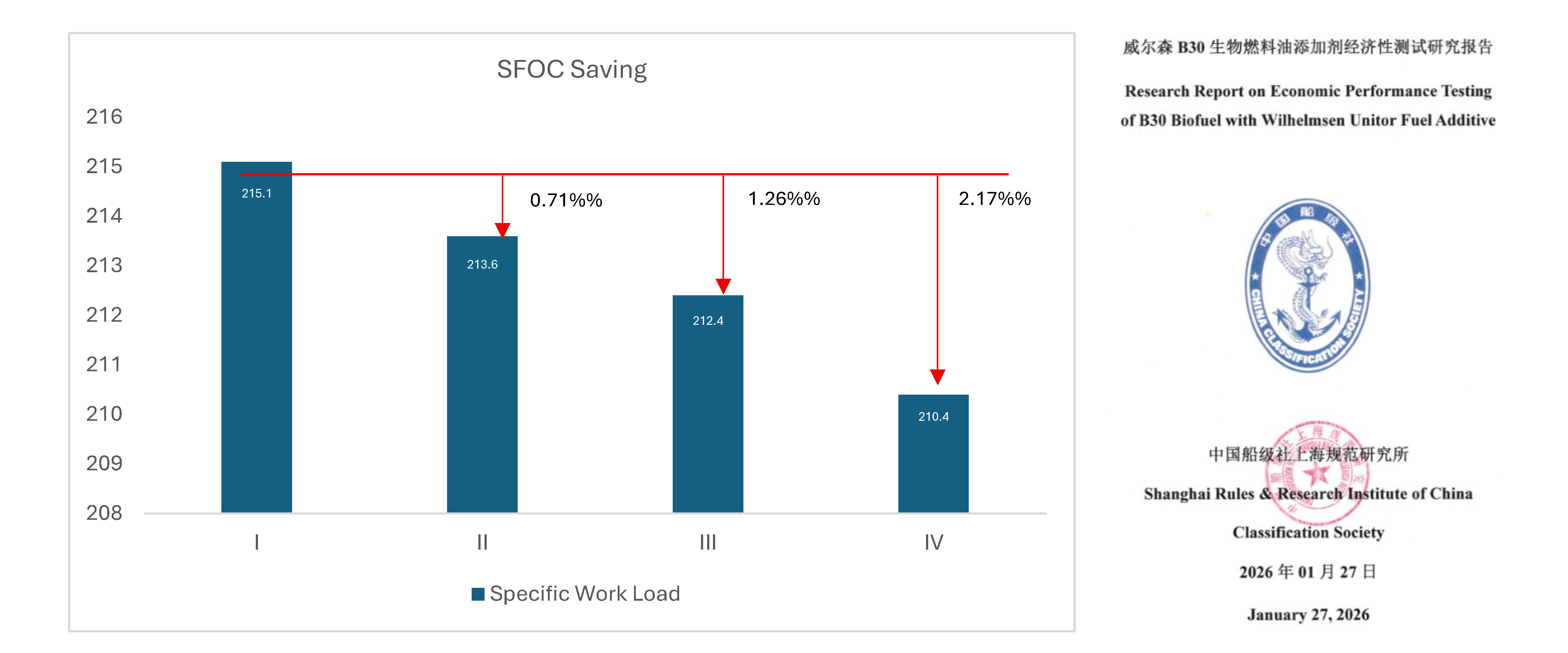
Results summary:
- Specific fuel oil consumption reduction of 1.51% to 2.17% relative to the untreated baseline fuel.
- Weighted specific fuel oil consumption reduction of 1.31%, calculated in accordance with CB/T 3254.2-2013 and GB/T 6072.1-2008
Calculated savings on conventional VLSFO
| Assumption | Value |
| VLSFO Energy Density | 42.7 MJ/KG |
| B30 VLSFO Energy Density | 41.65 MJ/KG |
| Energy Density Ratio | 41.65/42.7 = 0.975 |
| If 1.5% SFOC saving on B30, SFOC on VLSFO | 1.5%/0.7 x 0.975 = 2.09% |
| Equal to 1MT VLSFO saving per day given that 50 MT/day consumption | |
Fuelpower Catalyst delivered over 6% Estimated Cetane Number (ECN) improvement, measured in accordance with IP 541 using FIA/FCA‑100 constant‑volume combustion analysis by an independent third‑party laboratory. The ECN increase is consistent with improved combustion behaviour and aligns with the China Classification Society‑witnessed SFOC reduction on a MAN 6S35ME‑B9 engine.
Fuelpower Conditioner has been assessed under the Lloyd’s Register Additives Performance Certification (APC) framework, demonstrating up to 46% sludge reduction. This supports cleaner fuel systems and uninterrupted fuel injection, which are critical for maintaining consistent combustion performance.
This level of class involvement gives the results practical weight as part of a CII strategy, including incorporation into SEEMP Part III.
Oxidation stability validation (~31% improvement) on B100 FAME biodiesel
Wilhelmsen initiated a structured evaluation program to investigate the performance of Dieselpower BioEnhancer for biodiesel applications. The reference fuel selected was B100 FAME biodiesel. Additive samples were supplied by Wilhelmsen and tested independently by Bureau Veritas laboratories to ensure objectivity and traceability
Test methodology:
Oxidation stability was assessed using EN 15751 (Rancimat), the method reference by ISO 8217:2024 for distillate FAME
Two biodiesel samples were prepared for comparative evaluation:
- Control sample: Non‑additised B100 biodiesel
- Treated sample: B100 biodiesel additised by Dieselpower BioEnhancer
To assess storage resilience, both samples were subjected to accelerated ageing for 12 weeks at 35°C, with increased air–fuel exposure to represent challenging onboard storage conditions
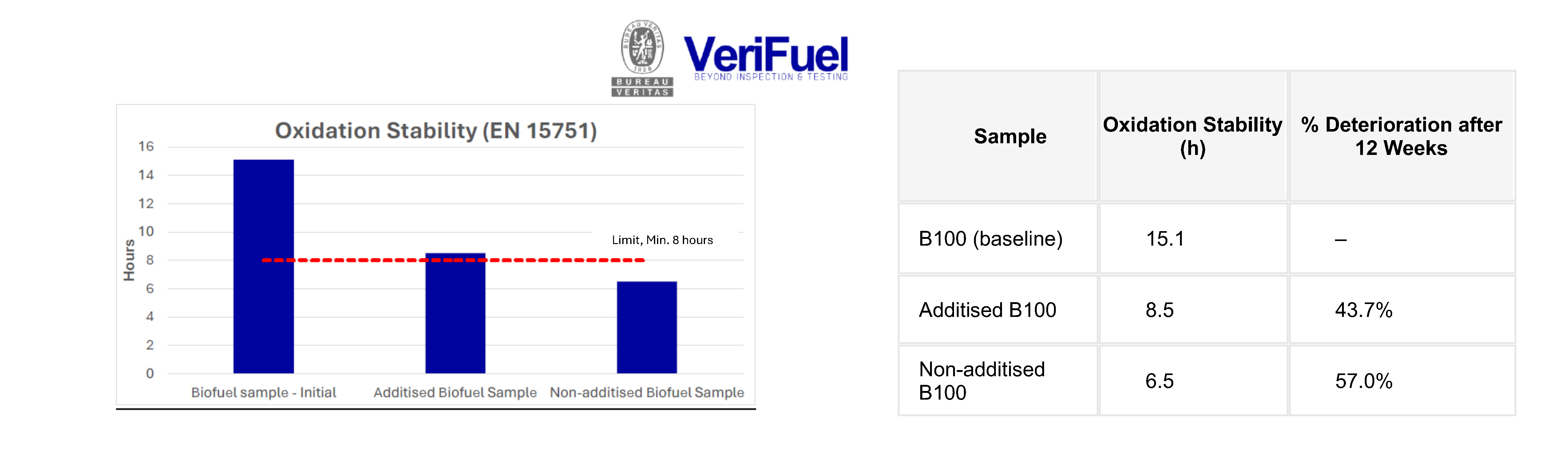
Results:
Initial oxidation stability: 15.1 hours
After 12‑week ageing:
- Additised B100: 8.5 hours (43.7% deterioration)
- Non‑additised B100: 6.5 hours (57.0% deterioration)
After ageing, the additised fuel maintained an oxidation stability value approximately 31% higher than the untreated fuel and remained above the EN 15751 minimum requirement of 8 hours, whereas the untreated sample measured 6.5 hours, falling below the EN 15751 minimum requirement and rendering the fuel out of specification.
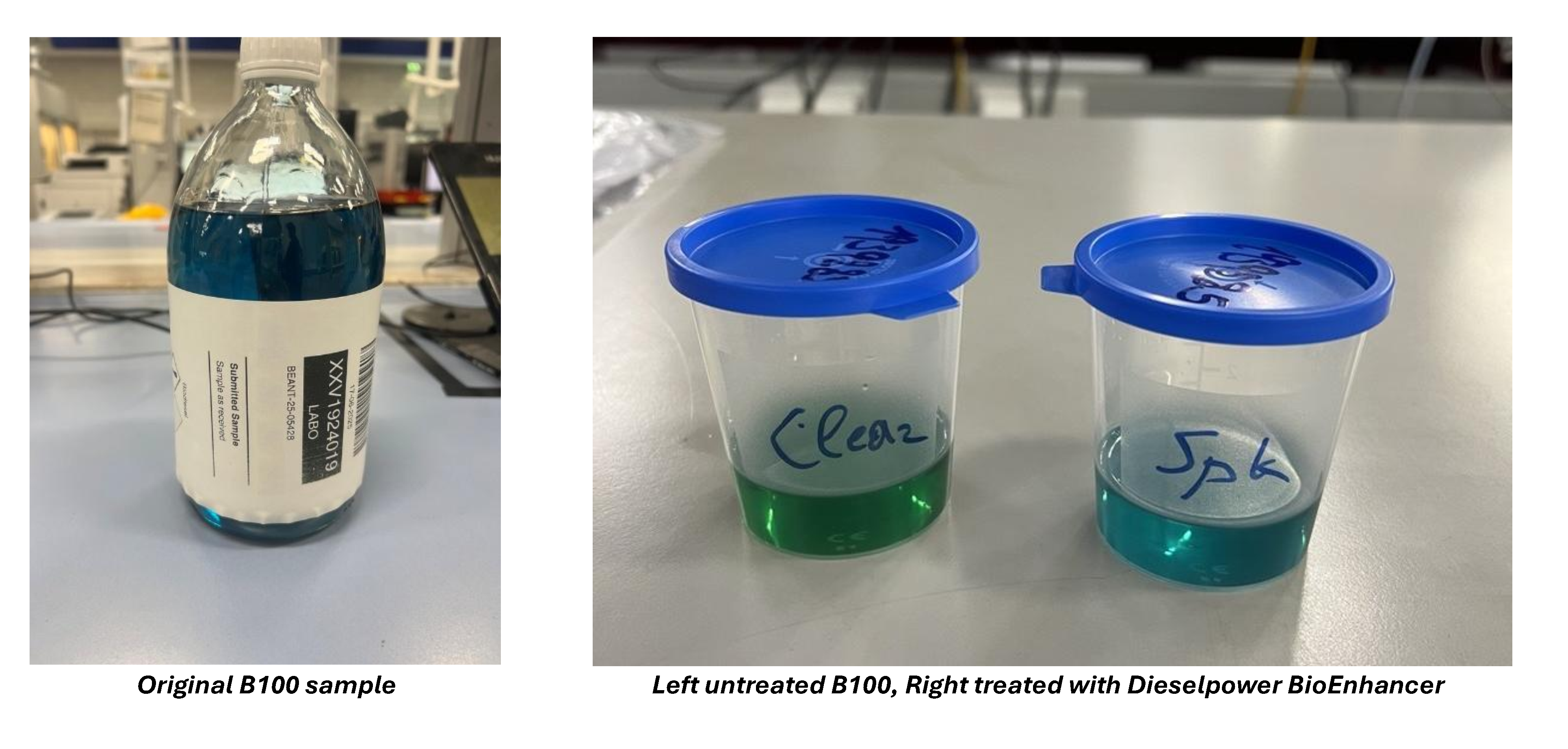
Visual inspection showed clear discoloration and degradation in the non‑additised sample, while the additised fuel retained its original appearance throughout the ageing period.
*Important clarification:
This evaluation addresses fuel stability and storage protection ONLY and does not make any fuel saving claim.
1 standard, 2 Fuel Classes with proven outcomes.
Wilhelmsen Ships Service has demonstrated validated additive performance across both fuel classes where fatty acid methyl ester (FAME) is present:
Residual fuels (B30 VLSFO)
Verified fuel economy improvement under class‑supervised, controlled shop‑trial engine testing
Distillate fuels (B100 FAME)
Verified oxidation stability and extended storage resilience through independent laboratory evaluation
It is engineered, tested, and verified performance, aligned with ISO 8217:2024 and CIMAC guidance for modern marine fuels
Ready to try these on your vessel? Talk to your local Wilhelmsen technical rep or fill our enquiry form to get in touch!
If you'd like to find out more, download our flyer below:
Case study
A bulk carrier faced purifier shutdown every few minutes from unstable VLSFO. See how structured fuel treatment saved 150 tons and avoided $75K loss.
Read it hereBoost efficiency and manage assets
Control fuel performance across storage, combustion, and exhaust to reduce losses, protect assets, and improve emissions performance.
Explore the tank to wake approachArticles you might be interested in
-
How to choose the right fuel and lube oil test kit for your vessel
This guide is intended to support chief engineers and technical superintendents in selecting onboard test kits that align with vessel size, engine configuration, fuel strategy, and operating profile.
-
Safeguarding your fuel system
Microbial contamination: the silent threat hiding in your fuel tanks as marine fuels evolve, so do the risks. Microbial growth fueled by water ingress is quietly degrading fuel quality, threatening vessel safety, and driving up maintenance costs. In this article, Wilhelmsen experts unveil the Prevent – Test – Treat (PTT) methodology, an integrated, proactive approach to fuel management that helps you stay ahead of microbial risk. Discover how simple steps can protect your fuel, your crew, and your bottom line. Read on and contact us to safeguard your operations.
Wilhelmsen insights |
Alex Qiang, Head of Product Management - Fuel & Lubricant Solutions -
Embrace fuel diversity for the future
Post IMO 2020, the fuel challenges remain unchanged while being more complicated when Very Low Sulphur Fuel Oil (VLSFO) was implemented in 2020 to be compliant with IMO 2020 regulation. The fuel diversity in the market including residual fuel type (HSFO/VLSFO/ULSFO), distillate fuel type (LSMGO/Diesel), Bio-blends (Bio-VLSFO/HFO, Bio-LSMGO), etc. Invite new challenges and risks.
Wilhelmsen insights |
Alex Qiang, Head of Product Management - Energy Solutions -
Managing fuel quality issues and meeting regulatory requirements
For shipowners and operators, maintaining fuel quality at a time of tightening regulation requires a clear understanding of the challenges
Wilhelmsen insights |
Shawn Lim, Head of Technical Sales and Business Development East, WSS Emissions, Fuels & Lubes