
Mooring rope certificates explained: How to spot a reliable anti snap-back rope
Mooring is still one of the most dangerous jobs on deck — and a rope that parts can injure or kill. Despite better materials and clearer guidelines, serious deficiencies in mooring equipment and rope management remain widespread, and injuries from rope parting stay at an alarming level.
Section 10 is consistently among the top five findings in RightShip's RISQ inspections, making it more important than ever to understand what different certificates actually verify and why it matters.
Why the right certificate matters
The gap between paperwork and reality can be wide. In independent testing of conventional mooring ropes from a range of manufacturers, a majority were measured below their declared breaking force, Alarmingly, some fell below the 75% retirement threshold set by MEG4 for ropes in service despite being brand new and unused. Several ropes sold as “anti snap-back” had no functioning anti snap-back element at all, failed to provide any snap-back reducing effect and a number were delivered without a valid rope certificate.
In other words, a confident-looking certificate does not guarantee a safe rope. What protects your crew is knowing which document genuinely verifies performance, which standards it complies with, and who signed off on the certification.
The main types of mooring rope certificate
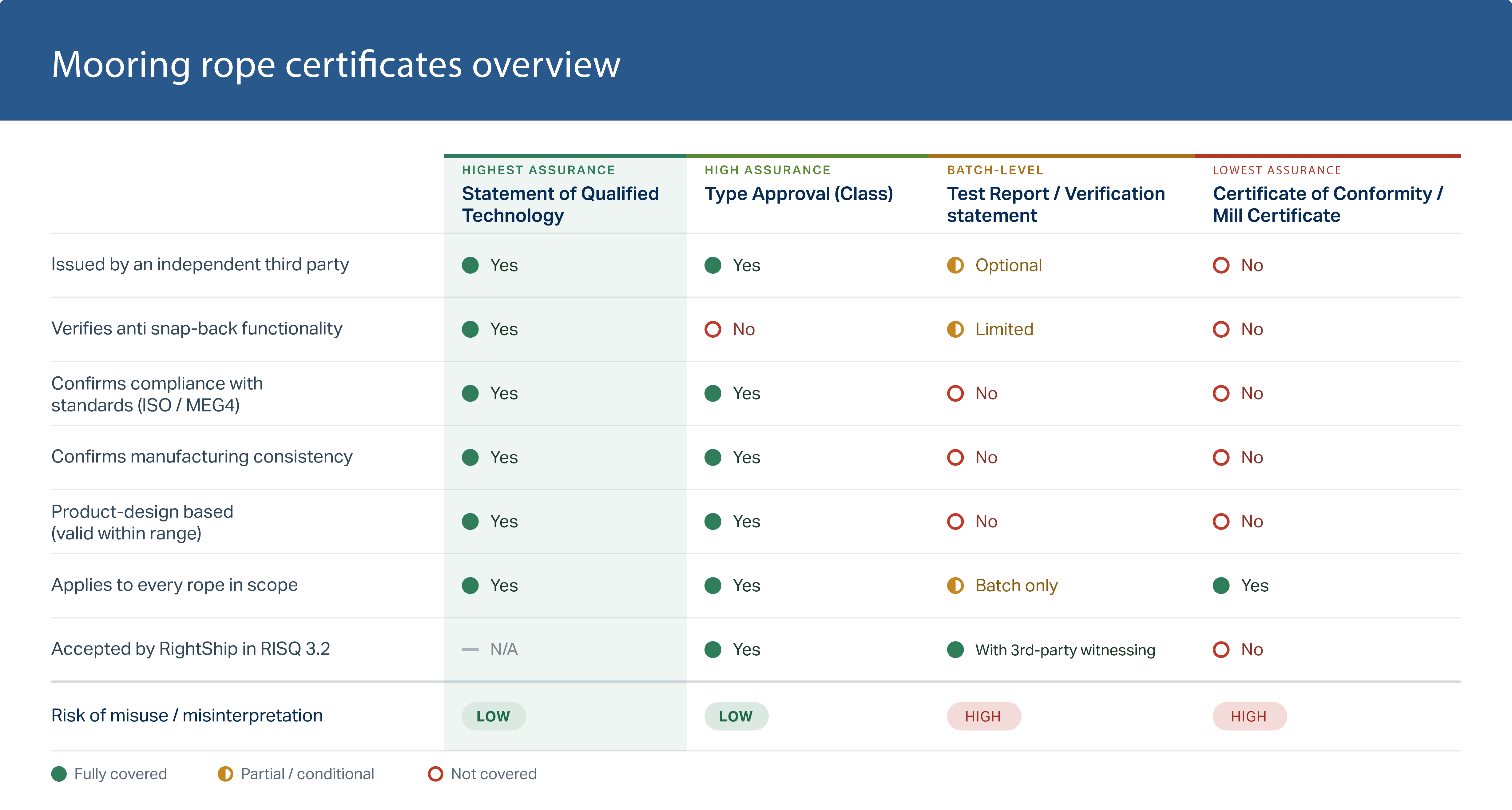
The certificates below are listed from the weakest to the strongest form of proof. The further down the list, the more independent the verification and the lower the risk of misuse or misinterpretation.
-
Certificate of conformity/Mill test certificate
A certificate of conformity (CoC) or mill certificate is issued by the manufacturer to confirm the product meets the performance requirements in its own specification. It may include results of internal testing, but those tests are typically not verified by a third party, and the document often references no ISO standard or industry guideline and gives no minimum breaking load (MBL) as required by MEG4 and SOLAS.
Because the manufacturer is both maker and certifier, conformity is self-declared. That is why it carries the highest risk of misinterpretation and why a mill certificate / certificate of conformity is not accepted by RightShip under RISQ 3.2.
-
Verification statement / Batch test report (third-party witnessing)
A verification statement confirms that a surveyor from a class society witnessed the product test against the standards listed in the statement, usually including review and approval of the test reports. For an anti snap-back rope, third-party witnessing can verify the anti-snap-back performance, but only for a unique rope or a single batch, and only within the limits of the test facility.
A batch test report is accepted by RightShip when it includes third-party witnessing, but its scope never extends beyond the batch that was tested.
-
Mooring line certificate (MEG4 certificate)
Introduced in the fourth edition of the OCIMF Mooring Equipment Guidelines (MEG4), the mooring line certificate is completed by the manufacturer for each mooring line or tail supplied. It summarises the design and performance of that specific line and the supporting documentation for the design range.
Its performance indicators come from the specific tests defined in MEG4. Crucially, no MEG4 test currently relates to the anti snap-back element, so the indicators describe the rope only, not its snap-back behaviour.
-
Type approval certificate
Type approval is a procedure for approving a product against the relevant industry standards. The design is assessed once by an independent certification body (associated with IACS), and the approval then applies to every product of the same design within a defined range. It covers both the performance and the manufacturing of the rope.
Type approval stands above the other rope certificates because it:
- Is issued by an independent third party — not the manufacturer.
- Confirms compliance with ISO standards and MEG4.
- Confirms manufacturing consistency, not just a one-off sample.
- Is product-design based and applies to every rope supplied within the scope of the certificate.
- Is accepted by RightShip under RISQ 3.2, with a low risk of misuse or misinterpretation.
Important thing to keep in mind: type approval certifies the rope, its performance and manufacturing, but it does not by itself verify that an anti-snap-back element works. That is the gap we cover in the final section.
How to verify a type approval certificate
A genuine type approval can be checked quickly against the issuing class society’s public database. Take the certificate number from the document and search. Here are some examples of class society search tools:
- ClassNK — List of Approved Materials and Equipment.
- ABS — Type Approval Database.
- BV — Approval Explorer.
- LR — LR Approvals Search
- DNV — CMC Approval Finder (search by certificate number, e.g. a TAK number).
If the number does not return a matching, current record, treat the certificate with caution.
Mooring rope certificates at a glance
Red flags to watch for on a certificate
Before you accept any certificate, scan it for these warning signs:
- No serial number linking the document to the physical product.
- No third-party approval the rope is certified by the manufacturer alone.
- Multiple class and regulatory logos crowded together to imply endorsement.
- Details that don’t match the class society’s online database.
- Serial numbers that differ between the certificate and the rope itself.
What about the snap-back function?
Here is the point every buyer of an anti-snap-back rope needs to understand: type approval, MEG4 and mill certificates all describe the rope. None of them verifies that the anti-snap-back element actually works.
Only an independent technology qualification by a recognized class society, such as a DNV Statement of Qualified Technology, assesses and qualifies the technology itself, providing independent verification of its intended performance.
In November 2022, DNV awarded Wilhelmsen Ships Service a Statement of Qualified Technology for the Timm Snap Back Arrestor (SBA™) making us the first and only manufacturer to receive such a qualification for an anti-snap-back rope.
The statement is issued only after an extensive qualification process carried out under DNV’s recommended practice DNV-RP-A203, which gives a systematic, traceable way to identify and verify every credible threat and failure mode of a new technology.
For the Timm by Wilhelmsen SBA™, that meant:
- Over four years of planning, testing and analysis; around 750 hours of laboratory testing.
- Verification of performance in the most severe scenarios and in real operational conditions on board vessels.
- Assessment of the SBA™ as a system, together with the other elements of the mooring arrangement, not performance in isolation.
- Review of ropes returned from service and feedback from real cases of ropes snapping, with field experience feeding back to prove the technology’s maturity.
Importantly, the SBA™ reduces but does not eliminate the snap-back effect. It lowers the risk while crews maintain proper safety precautions and snap-back zones.
Choosing with confidence
Vessel mooring remains a dangerous operation, and severe incidents still happen today. Strong certification is one of the key safeguards buyers can use to reduce risk before a rope ever reaches the vessel. Favour independent, design-based type approval for the rope, and a Statement of Qualified Technology for the anti snap-back function and always verify the paperwork against the class society’s own records.
Visit our New era of safer mooring page to see how certified ropes, the Timm SBA™, technical support and digital tools come together to make your operations safer.