How holistic fuel management supports cleaner and more efficient vessel operations
The maritime industry's decarbonisation conversation has moved decisively toward Well-to-Wake to account for carbon not just from combustion, but from extraction, refining, and transport of fuel through to exhaust. It is the right framework for regulatory reporting, for CII ratings, and for understanding a fuel's true lifecycle emissions footprint.
While the industry is aligning around Well-to-Wake (WtW) thinking, one reality remains unchanged: Ship operators control performance primarily onboard which is from Tank to wake (TtW).
Tank-to-Wake is a systematic approach covering the entire onboard fuel lifecycle from the moment fuel enters your storage tanks to the moment exhaust gases leave the stack. It is a systematic approach covering the entire onboard fuel lifecycle, from storage to exhaust:
- Pre-combustion: fuel stability, storage, compatibility
- Combustion: burn efficiency, atomization, energy conversion
- Post-combustion: soot control, heat recovery, system cleanliness
Losses occur at every stage. And crucially, losses in the early stages compound into losses downstream. Fuel that degrades in storage produces sludge that never reaches the engine. Fuel that ignites poorly generates excess soot that then deposits on heat recovery surfaces, reducing the efficiency of every subsequent combustion cycle. The system is interconnected and it responds to being managed as one.
This is where a holistic fuel management approach delivers immediate value ensuring that every tonne of fuel bunkered is effectively converted into propulsion, rather than wasted through instability, inefficiency, or poor system control.
Pre-combustion: fuel that reaches the engine at full value
Modern marine fuels particularly VLSFO and bio-blends are prone to sludging and incompatibility. 1–3% of fuel can be lost as sludge, even small percentages of fuel lost to sludge represent paid energy that is not converted into propulsion. For example, 2% loss in 150 MT of fuel at $600 per ton accounts for $90,000 loss.
Two products address this stage of the Tank-to-Wake chain.
1) FuelPower Conditioner
FuelPower Conditioner was independently assessed by Lloyd’s Register FOBAS through a Product Performance Assessment using controlled laboratory Hotspin testing. The Hotspin results showed improved separation and sludge behaviour across all tested samples, with improvements up to 46%. This supports a Tank-to-Wake approach by helping more of the bunkered fuel remain available for efficient use rather than being lost through sludge generation and fuel handling issues. CIMAC notes that FAME-containing fuels can absorb significantly more water than conventional diesel or HVO, increasing the risk of microbial activity, sludge formation, filter blocking and fuel degradation. In this context, pre-combustion fuel management becomes critical. This is where DieselPower Bio Enhancer fits into the Tank-to-Wake chain.
2) DieselPower Bio Enhancer
DieselPower Bio Enhancer is a multifunctional treatment for diesel fuel, biofuels and bio-blends, formulated to improve oxidation stability, protect against corrosion, reduce foaming tendency, remove and prevent injector deposits, and maintain good water separability. In independent project testing,the study showed that after 12 weeks of accelerated ageing, the DieselPower Bio Enhancer-treated B100 FAME sample retained higher oxidation stability than the untreated sample (8.5 hours vs. 6.5 hours) representing about 30.8% higher remaining oxidation stability and continued compliance with the 8-hour minimum requirement under EN 14214 / ISO 8217:2024.
During combustion: improving how efficiently fuel energy is released
Once fuel reaches the combustion stage, Tank-to-Wake performance depends on how effectively the fuel’s chemical energy is converted into useful engine output. Poor ignition quality leads to longer ignition delay, incomplete combustion, higher soot formation, and ultimately higher specific fuel oil consumption (SFOC) for the same power output.
This is where FuelPower Catalyst supports the combustion phase of the onboard fuel lifecycle. The product is designed to improve combustion using an iron-based catalyst, supporting reduced ignition delay, cleaner combustion, lower soot formation, and cleaner engine and exhaust gas boiler operation.
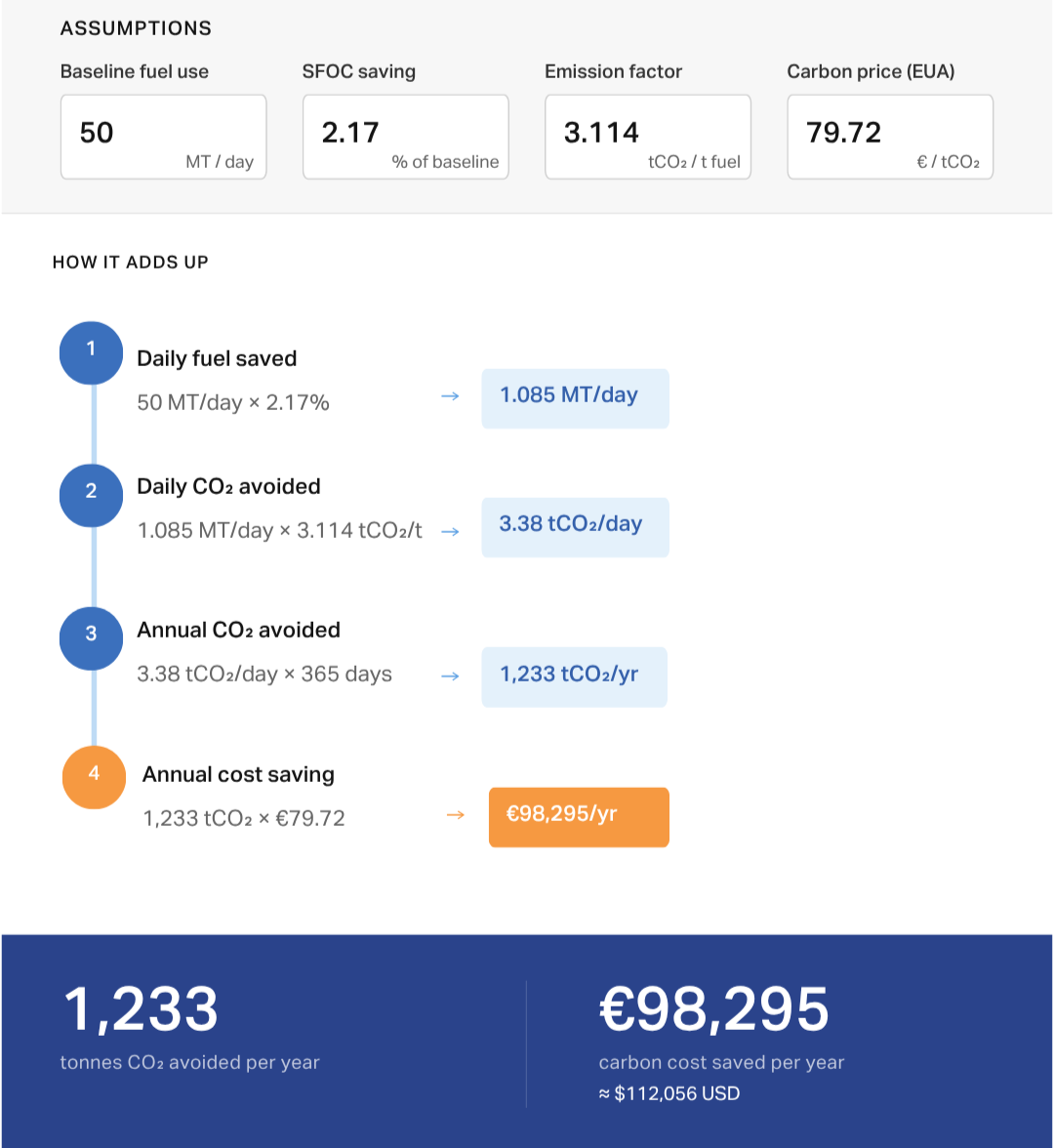
FuelPower Catalyst delivered over 6% Estimated Cetane Number (ECN) improvement, measured in accordance with IP 541 by an independent third‑party laboratory. This laboratory result was further supported by a jointly witnessed engine trial with China Classification Society (CCS) on a MAN B&W 6S35ME-B9 two-stroke low-speed marine diesel engine using B30 VLSFO. The combined treatment approach with FuelPower Catalyst and FuelPower Conditioner demonstrated an observed SFOC reduction of 1.51% to 2.17%.
Post-combustion: protecting heat recovery and exhaust system efficiency
Tank-to-Wake performance does not end at the piston. After combustion, exhaust gases carry soot, unburnt carbon particles, and combustion by-products through the turbocharger, exhaust gas boiler, economiser, and ducting before reaching the stack.
Soot and firescale deposits on heat recovery surfaces are not merely a housekeeping issue. They reduce heat transfer efficiency, increase differential pressure across the exhaust gas boiler, raise the frequency and cost of manual cleaning, and create conditions for soot fires. For vessels operating in slow-steaming mode, where lower exhaust temperatures allow soot to accumulate more rapidly, this risk is elevated.
FuelPower Soot Remover Liquid Plus and Fuelpower Soot Remover are powerful solutions that prevents soot and deposits and ensure your exhaust systems stay clean and efficient. Fuelpower Soot Remover remains relevant for higher-temperature exhaust conditions, while FuelPower Soot Remover Liquid Plus is particularly suited for slow steaming, where lower exhaust temperatures can accelerate soot accumulation and reduce exhaust gas boiler efficiency.
In a documented RoRo vessel trial, FuelPower Soot Remover Liquid Plus helped extend the exhaust gas boiler cleaning interval to 16 months, compared with the previous two-month cleaning interval, supporting cleaner heat-transfer surfaces, more stable exhaust gas boiler performance and reduced maintenance demand.
The compounding benefits of integrated fuel management
A fuel that arrives at the combustion stage with degraded stability burns less efficiently, generates more soot, deposits more rapidly on exhaust surfaces, and reduces the efficiency of every combustion cycle that follows.
Operators who address pre-combustion stability, combustion quality, and post-combustion cleanliness as an integrated programme consistently report outcomes that exceed what any single intervention achieves. Reduced sludge loss. Lower SFOC. Fewer unplanned maintenance events. Extended cleaning intervals. And a measurable, documented improvement in fuel efficiency that flows through to CII calculations.
This is what a holistic fuel management approach delivers: not a marginal improvement in one metric, but a controlled, systematically optimised onboard fuel system in which every tonne bunkered has a credible chance of contributing fully to propulsion.
The Tank-to-Wake opportunity varies by vessel, trade route, fuel type, and current treatment programme. A container ship running VLSFO has different pre-combustion risks than a ferry operating on B30 blends. A vessel slow steaming on a long Pacific crossing faces different post-combustion challenges than one on high-load North Sea trades.
Unitor™’s fuel treatment specialists work with technical managers and superintendents to assess the specific losses in a vessel's current onboard fuel chain and identify where treatment delivers the clearest return. If you are managing fuel efficiency improvements for CII compliance, exploring bio-blend handling for FuelEU Maritime, or simply trying to understand where your fuel spend is going, reach out to our Expert to optimise your fuel management.
Boost efficiency and manage assets
Control fuel performance across storage, combustion, and exhaust to reduce losses, protect assets, and improve emissions performance.
Explore the tank to wake approachArticles you might be interested in
-
How to choose the right fuel and lube oil test kit for your vessel
This guide is intended to support chief engineers and technical superintendents in selecting onboard test kits that align with vessel size, engine configuration, fuel strategy, and operating profile.
-

Safeguarding your fuel system
Microbial contamination: the silent threat hiding in your fuel tanks as marine fuels evolve, so do the risks. Microbial growth fueled by water ingress is quietly degrading fuel quality, threatening vessel safety, and driving up maintenance costs. In this article, Wilhelmsen experts unveil the Prevent – Test – Treat (PTT) methodology, an integrated, proactive approach to fuel management that helps you stay ahead of microbial risk. Discover how simple steps can protect your fuel, your crew, and your bottom line. Read on and contact us to safeguard your operations.
Wilhelmsen insights |
Alex Qiang, Head of Product Management - Fuel & Lubricant Solutions -
Embrace fuel diversity for the future
Post IMO 2020, the fuel challenges remain unchanged while being more complicated when Very Low Sulphur Fuel Oil (VLSFO) was implemented in 2020 to be compliant with IMO 2020 regulation. The fuel diversity in the market including residual fuel type (HSFO/VLSFO/ULSFO), distillate fuel type (LSMGO/Diesel), Bio-blends (Bio-VLSFO/HFO, Bio-LSMGO), etc. Invite new challenges and risks.
Wilhelmsen insights |
Alex Qiang, Head of Product Management - Energy Solutions -
Managing fuel quality issues and meeting regulatory requirements
For shipowners and operators, maintaining fuel quality at a time of tightening regulation requires a clear understanding of the challenges
Wilhelmsen insights |
Shawn Lim, Head of Technical Sales and Business Development East, WSS Emissions, Fuels & Lubes