EU ETS and FuelEU Maritime Compliance
Two key EU regulations, the EU Emissions Trading System (EU ETS) and FuelEU Maritime, aim to decarbonize maritime transport by imposing emissions monitoring and fuel greenhouse gas intensity reduction requirements on ships operating in EU ports.
The European Union has introduced two major regulatory frameworks aimed at decarbonising maritime transport: the EU Emissions Trading System (EU ETS) and the FuelEU Maritime regulation. Hecla Emissions Management AS is a joint venture between Wilhelmsen Ship Management, part of the Wilh. Wilhelmsen Group, and shipbroker Affinity Shipping LLP. Hecla offers tailored solutions for both regulations to help shipowners and managers stay ahead of their obligations.
EU ETS Compliance
As of January 2024, shipping has been included in the EU ETS. This regulation mandates that vessels over 5,000 gross tons calling at EU and EEA ports must monitor, report, and verify their CO₂ emissions, with corresponding allowance surrender obligations.
Our EU ETS Compliance Services
- Handling of Verified Data: Integration with third-party verifiers and secure management of emissions data via Hecla’s digital platform.
- Registry Account Management: Legally compliant account creation and transaction management.
- Procurement of Allowances: Access to the EU carbon market for buying and selling EU Allowances (EUAs).
- Annual Surrendering: Matching verified emissions with registry holdings to ensure timely allowance surrender.
- Commercial Advice: Tailored guidance to align your commercial strategy with regulatory compliance.
Through our joint venture, Hecla Emissions Management AS, we centralise the ETS value chain in a single, customer-centric digital workflow—ensuring control, transparency, and reliability across the process.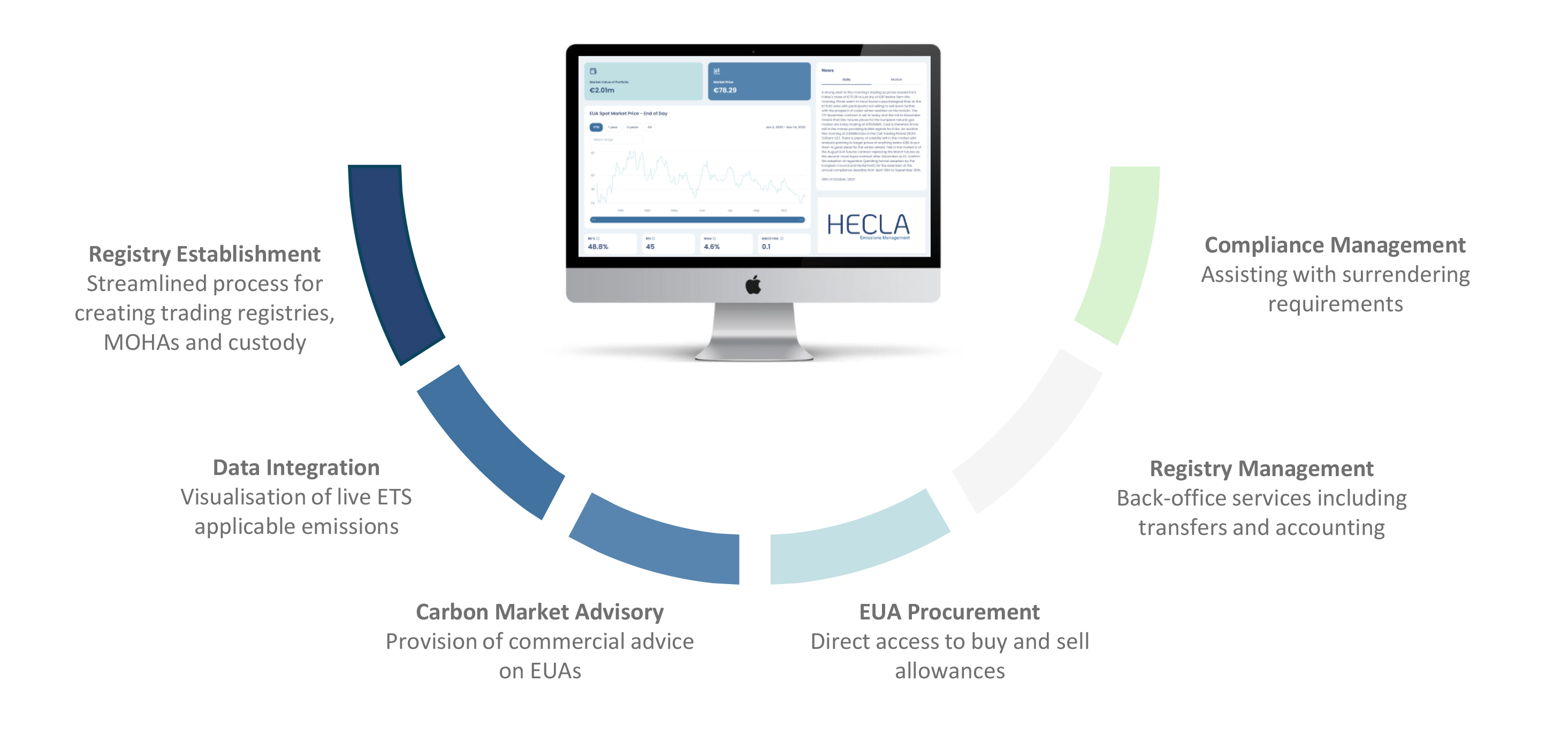
EU ETS Implementation Timeline (Shipping)
To ease the transition, the EU has implemented a phased approach to shipping under EU ETS:
- 2024: 40% of verified emissions must be covered by allowances
- 2025: 70%
- 2026 onward: 100%
This applies to:
- 100% of emissions from intra-EU voyages
- 50% of emissions from voyages entering or leaving the EU
FuelEU Maritime Compliance
Effective 1 January 2025, the FuelEU Maritime regulation requires ships operating in EU ports to gradually reduce the greenhouse gas (GHG) intensity of the fuels they use. This regulation is part of the EU’s broader commitment to climate neutrality by 2050. Unlike EU ETS, which focuses on emissions output, FuelEU mandates a gradual reduction in the environmental impact of the fuel itself.
How Ship Owners Can Comply
- Reduce GHG Intensity: The core obligation is to lower the GHG emissions per unit of energy consumed by their vessels. This involves using fuels with lower carbon footprints.
- Adopt Renewable and Low-Carbon Fuels: Use alternatives like biofuels and e-fuels to lower fuel-related emissions and support compliance.
- Use Onshore Power Supply (OPS): Larger passenger and container ships must connect to OPS when available in EU ports to reduce emissions while docked.
- Monitor and Report: Accurate tracking of fuel consumption, GHG emissions, and fuel types is essential for compliance and reporting to authorities.
- Paying Penalties: Penalties are calculated based on the amount of non-compliant fuel used.
- Flexibility Mechanisms: Ship owners can explore options like pooling, banking, and borrowing of GHG intensity targets to manage compliance challenges:
- Pooling: If there is a surplus or an excess on a ship’s GHG intensity targets, it can be pooled to be exchanged and compensated for other non-compliant ships within a single company or across companies.
- Banking: The surplus can be banked to meet the following year’s intensity target for the same vessel.
- Borrowing: Allows a company to borrow a future year’s anticipated surplus to meet the current year’s target instead, along with a borrowing penalty for that year’s target period.
FuelEU Reduction Timeline
- By 2% from 2025
- By 6% from 2030
- By 14.5% from 2035
- By 31% from 2040
- By 62% from 2045
- By 80% from 2050
Ship managers play a critical role in guiding shipowners through technical adaptation, data reporting, crew training, and stakeholder coordination. Wilhelmsen Ship Management provides full-scope support to help clients meet their regulatory obligations effectively.
Trading Surplus Compliance Balances
Hecla Emissions Management AS leads the way in FuelEU compliance with its innovative FuelEU Maritime Exchange (FME) platform — the dedicated marketplace for assigning and trading FuelEU Maritime compliance balances. This pioneering initiative incentivizes companies that exceed their FuelEU compliance targets by allowing them to trade their surplus compliance balances.
Why Partner with Us
- Independent platform supporting both EU ETS and FuelEU Maritime compliance
- Unified system for emissions data, reporting, and allowance or compliance balance management
- Full-scope support covering regulatory obligations, strategy, and data integrity
- Experience across diverse vessel types and global operations
Contact us today to learn how our combined EU ETS and FuelEU Maritime services can streamline your regulatory management and support your decarbonisation ambitions.