Understanding EAL in marine lubrication
EAL stands for Environmentally Acceptable Lubricant, it is a lubricant designed to have a lower impact on the marine environment if it leaks, spills, or comes into contact with seawater. The Vessel General Permit (VGP), established by U.S Environmental Protection Agency (EPA)) aims to control and reduce pollution of U.S. water originating from discharges incidental to the normal operation of a vessel. The VGP plays a vital role in maintain the health of U.S. waters by regulating discharges that can harm marine life and water quality. It mandates the adoption of environmentally friendly technologies for those oil-to-sea interface application points, among which EAL lubricant is one of the key influential factors. EPA defines EALs as lubricants that are biodegradable, minimally toxic, and non-bioaccumulative.
The VGP applies to commercial vessels that are 25 meters (82 feet) or longer and discharge incidental wastewater into U.S. waters, including:
- Commericial vessels: cargo ships, tankers, bulk carriers, container ships, passenger vessels (cruise ships, ferries), fishing vessels (over 79 feet), and offshore supply vessels
- Vessels operating in U.S. waters: any eligible vessel navigating within the U.S. three nautical mile territorial sea or inland waters
- Vessels with incidental discharges: ships that release ballast water, bilge water, deck runoff, greywater, and other operational discharges.
The Vessel Incidental Discharge Act (VIDA) is expected to replace VGP system soon, which would further mandates the usage of EAL lubricant for oil-to-sea interface points. For shipping and offshore operations, EAL lubricant is not only a performance product; it is also part of the vessel’s environmental responsibility.
Why EAL matters
Increasing regulatory and ESG-driven requirements are accelerating the adoption of environmentally acceptable lubricants (EALs) in marine applications where an oil-to-water interface exists. In addition to the EPA EAL definition (readily biodegradable, minimally toxic, and non-bioaccumulative), voluntary ecolabelling schemes such as the EU Ecolabel and Nordic Swan apply environmental hazard-screening criteria that further support the selection of low aquatic-impact lubricant formulations for water-exposed systems.
EALs are specified to minimise the environmental consequence of operationally unavoidable leakage or incidental discharge to the aquatic environment. By contrast, conventional mineral or synthetic lubricants may provide robust tribological protection, but any loss overboard can introduce pollution liabilities and non-compliance risk. Correctly selected EALs are engineered to deliver the required load-carrying, anti-wear, corrosion protection and water tolerance while reducing persistence, toxicity and bioaccumulation potential in the event of release, thereby supporting marine pollution prevention.
For vessel owners and operators, this is especially relevant in systems such as stern tubes, thrusters, stabilisers, controllable pitch propellers, rudders, and other equipment with an oil-to-sea interface. In those cases, choosing the right lubricant is not just a technical decision; it is also a compliance and sustainability decision.
What makes a lubricant EAL?
A lubricant generally needs to meet three core environmental characteristics to be considered an EAL: it must be biodegradable, minimally toxic, and non-bioaccumulative. These criteria are central to the EPA definition and are repeated across industry and marine guidance sources:
- Biodegradable: the constituent substances of a lubricant must naturally break down at least 60% of the formulation within 28 days
- Minimally toxic: the lubricant must not hinder the growth or well-being of aquatic life
- Non-bioaccumulative: the chemicals may not accumulate in the tissue of an organism and enter the food chain
In practice, EALs are often formulated from base stocks such as synthetic esters, natural esters, or polyglycols. These base oils are selected because they can support both environmental performance and the technical demands of marine equipment. Particularly, Klüber has developed and adopted saturated esters oil based EAL to provide outstanding performance against conventional mineral based and market available ester oil based technology
Are EALs only about compliance?
No. While compliance is a major driver, EAL selection is also about operational performance. Unique tribological know-how, raw materials of highest quality, customised additive packages and official approval from major leading OEMs, are backbone for benchmark-setting EAL products. Hydrodynamic oil film thickness, load carrying capacity, corrosion protection, water washout stability, resistance to hydrolysis and oxidation or low-termpeature performance. In other words, sustainability should not come at the expense of machinery protection and jeopardizing lubricant performance.
A good example of superior hydrodynamic oil film thickness with Klüberbio RM 2 stern tube oil represented in the chart below:
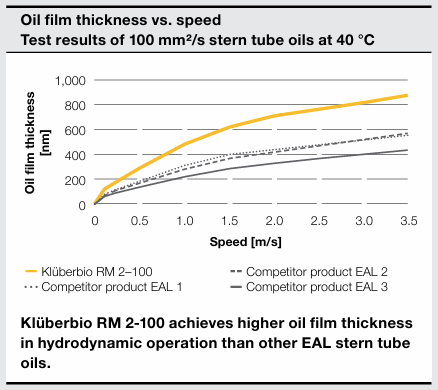
Higher oil film thickness indicates excellent protection under load carrying capacity under dynamic operation.
Another demonstration illustrates how Kluberbio RM 8-100 remains stable in the presence of water. The Beverage Bottle test according to the test norm ASTM D2619 is a suitable method. Hydrolytically unstable oils form acid as a product of chemical reaction of easter oils and water, which causes corrosion in a stern tube system or leads to incompatibility of the stern tube oil with the elastomer materials of the propeller shaft seals. The acid content in an oil can be measured by a titration with KOH. The result of such a titration is the TAN (mgKOH/g oil).
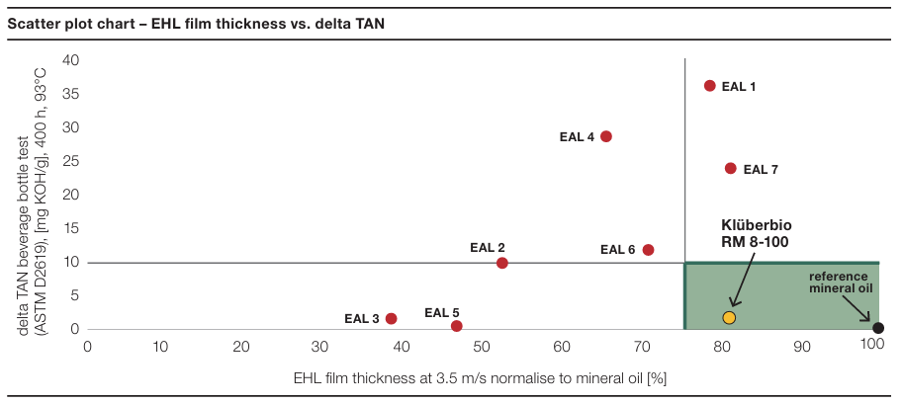
From above tests of various ester-based EALs, Klüberbio RM 8-100 shows by far the best test result and nearly no increase of the TAN, proving its excellent stability in the presence of water, even similar to the stability of mineral based stern tube oil
WSS, partnership with Kluber, has proven to ship operators who worry that “environmentally friendly” means “lower performance.” Klüber EALs product ranges are designed to perform in real applications, not just meet a label requirement.
Where EALs are used
EALs are commonly used in marine applications where lubricant loss to the environment is possible or likely. All water-to-oil interfaces should be taken into consideration. That includes equipment such as stern tubes, bow thrusters, stabilisers, rudders, wire ropes, and other submerged or exposed systems.
They are also relevant in deck machinery and auxiliary systems where leakage can happen overboard.
Under the VGP and incoming VIDA, deck runoff refers to washdowns and seawater that accumulate on the weather deck and are discharged overboard through deck openings. This type of runoff can carry pollutants, debris, and residues from vessel operations, making proper management and EAL usage essential to comply with environmental regulations. For many vessel operators, this makes EALs part of a broader strategy for cleaner, more responsible operations.
Wilhelmsen offers a range of EAL solutions from Klüber to support marine operators looking for environmentally responsible lubrication options without compromising on performance. That means you can choose products designed for both operational needs and environmental expectations.
Articles you might be interested in
-
Why speciality marine lubricants matter for drilling and production assets
Lubrication failures are one of the most frequent root causes of equipment damage offshore. For operators, these failures directly impact safety, uptime, and total cost of ownership.