
Is your blended fuel compatible? Simple onboard testing explained
Engine health depends not only on what fuel you buy, but on how different fuels behave once they are mixed on board.
As VLSFO formulations evolve and biofuel blends scale rapidly in response to CII and well-to-wake decarbonisation pressures, vessels are handling a wider range of fuel chemistries than ever before. Industry discussions at the 2026 Clean Fuels Conference reinforced a clear message: biofuels are no longer niche trial fuels, they are becoming mainstream transitional energy carriers.
The Guidelines on Use of Biofuels on Ships (Dec 2023) confirm that biofuels may be used as “drop-in” replacements or blends with conventional residual and distillate fuels; provided compatibility, material suitability, and operational controls are verified.
However, increasing adoption brings increasing variability:
- Wider feedstock diversity (waste oils, animal fats, crop-based sources)
- Greater blend ratios (B10 through B50 and beyond)
- Stronger scrutiny of fuel integrity, traceability and sustainability claims
- Growing emphasis on lifecycle carbon factors rather than tank-to-wake alone
Operationally, that means incompatibility risk is rising. Vessels are switching fuels more frequently, introducing FAME or HVO blends of varying percentages and managing multiple sulphur grades (HSFO, VLSFO, ULSFO).
This creates 3 realities that many vessels face: more chemical variability with different aromatic content, solvency behaviour, oxidation stability, cold-flow characteristics, and water affinity. Less blending predictability where even fuels compliant with ISO 8217 at delivery may destabilise when mixed. And higher operational consequence due to incompatibility of fuels that now affects not just engine reliability but emissions performance, carbon reporting accuracy, and compliance posture.
When incompatible fuels are mixed, the most common failure mechanism is asphaltene precipitation or instability-driven sludge formation. Operationally, this can appear as:
- Sludge accumulation in bunker, settling or service tanks
- Rapid filter clogging and increased backflushing
- Separator overload or repeated alarm trips
- Injector fouling and combustion deposits
- Rising specific fuel oil consumption (SFOC)
- Increased purifier discharge volumes
- Microbial growth risks (particularly in FAME blends with higher water affinity)
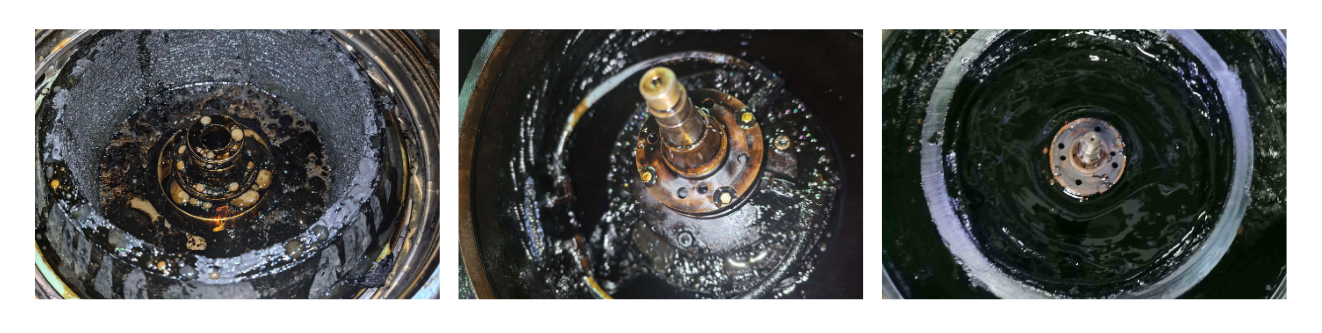
The IRS Guidelines specifically highlight stability, oxidation, acid number, water content, and microbiological degradation as risk parameters to be assessed.
In severe cases, operators have had to de‑bunker or segregate large volumes of fuel, or accept unplanned stops to clean systems. These are avoidable outcomes if compatibility is checked before fuels are mixed in operational tanks.
How simple on board fuel compatibility testing works
Compatibility testing does not need to be complex or lab‑based to be useful. A typical on board compatibility test kit allows the crew to:
1) Take representative samples from the existing tank and the new fuel to be introduced.
2) Mix the samples in defined proportions under controlled conditions, according to the kit instructions.
3) Observe the mixture after a specified period to see whether it remains clear/stable or shows signs of flocculation, haze, or sludge formation.
4) Judge whether large‑scale blending is safe, needs to be limited, or should be avoided.
The key is that this is done before connecting tanks or fully integrating the new fuel into the system. The test provides a visual decision indication, giving the chief engineer and superintendent time to decide on the safest way to proceed.
Compatibility, engine health, and emissions performance
Decarbonisation metrics are increasingly based on well-to-wake factors and weighted carbon conversion calculations. However, a fuel that improves reported CII performance can still degrade real-world efficiency if instability increases SFOC or causes combustion inefficiency. This creates a paradox where technically unstable low-carbon fuel may worsen operational emissions performance.
See table below for an operational view that reflects the engine-health implications by blend stage:
| Biofuel stage | Typical blend | Adoption context | Operational characteristics | Engine & CII implications |
| Transitional | B10 - B30 | Widely used; modest lifecycle gains |
|
|
| Intermediate | B25 - B50 | Charterer-driven scaling |
|
|
| High adoption | >B50 | Expanding in key hubs |
|
|
By integrating compatibility checks into your standard bunkering and fuel‑handling routines, you make it more likely that lower‑carbon fuels also deliver reliable, efficient operation on board.
A practical onboard workflow for new fuel batches
To maintain flexibility in fuel procurement and biofuel adoption while still protecting engine and system integrity, a simple, repeatable process might look like this:
1) Segregate the new fuel: receive it into a dedicated tank where it does not immediately mix with existing fuel.
2) Run a compatibility test: use an onboard compatibility test kit to check the new fuel against the fuel currently in use on board.
3) Plan the blending strategy: if the test indicates compatibility, plan a gradual blending and changeover. If incompatibility is indicated, consider using the fuel in isolation, limiting percentage blends, or consulting technical support before proceeding.
4) Blend under control: start with conservative blending ratios and monitor system behaviour closely especially the separator load, filter condition, and any changes in exhaust appearance or engine performance.
5) Monitor and adjust: track trends in purifier performance, filter differential pressures, and sludge output. Escalate to laboratory analysis if behaviour is unusual or deteriorating.
What to look for in an onboard compatibility test kit
For day‑to‑day use, a practical compatibility test kit should:
- Have clear, simple procedures that can be carried out by engineering crew without specialist lab training.
- Provide a visual, easy‑to‑interpret result (e.g. clear vs flocculated).
- Be suitable for VLSFO, distillates, and relevant biofuel blends.
- Be integrated into your broader fuel‑testing and treatment routines, rather than used in isolation.
Used consistently, such a kit becomes part of a wider engine‑health mindset: plan, verify, blend, monitor, and adjust. The Unitor™ Compatibility Test Kit (PN 773153) gives crews rapid, simple, and reliable insight into whether two fuels are likely to remain stable when blended.
Wilhelmsen Ships Service offers a complete solution for biofuel blends treatment and handling, facilitating onboard fuel management. It covers:
| On board issues | Solution |
| Sludge control and compatibility | Fuelpower Conditioner (PN 778785) |
| Energy efficiency improvement | Fuelpower Catalyst (PN 779096) |
| Cold flow mitigation | Fuelpower PPD VLSFO (PN 779118) |
| Anti-oxidation and detergency in BioDiesel or Bio-MGO | Dieselpower Bio Enhancer (PN 767340) |
| Microbial contamination prevention | Dieselpower BioControl (PN 779082) |
As fuel portfolios become more complex, the risk of blending incompatible fuels quietly increases. Compatibility testing is a relatively small step in time and cost, but it can prevent large operational, financial, and safety consequences.
By making compatibility checks part of your standard fuel‑handling practice, you give your crew a practical way to keep engine health first while still gaining the benefits of newer fuel options and decarbonisation strategies.
Articles you might be interested in
-
How to choose the right fuel and lube oil test kit for your vessel
This guide is intended to support chief engineers and technical superintendents in selecting onboard test kits that align with vessel size, engine configuration, fuel strategy, and operating profile.
-
Fuel Treatment: Efficiency gains more than just hot air
Systematic fuel treatment can unlock significant operational and financial gains - nowhere during the life cycle of fuel is this more evident than at its end, in the exhaust gas boiler.
威尔森观察 |
Jonas Östlund, Head of Product Management - Energy Solutions -
Embrace fuel diversity for the future
Post IMO 2020, the fuel challenges remain unchanged while being more complicated when Very Low Sulphur Fuel Oil (VLSFO) was implemented in 2020 to be compliant with IMO 2020 regulation. The fuel diversity in the market including residual fuel type (HSFO/VLSFO/ULSFO), distillate fuel type (LSMGO/Diesel), Bio-blends (Bio-VLSFO/HFO, Bio-LSMGO), etc. Invite new challenges and risks.
威尔森观察 |
Alex Qiang, Head of Product Management - Energy Solutions -
Managing fuel quality issues and meeting regulatory requirements
For shipowners and operators, maintaining fuel quality at a time of tightening regulation requires a clear understanding of the challenges
威尔森观察 |
Jonas Östlund, Head of Product Management - Energy Solutions